
EDGX Takes AI Computing Into Orbit: Why Satellites Are Starting to Process Data Before It Reaches Earth
- October 28, 2026
- Posted by: admin
- Category: Uncategorized
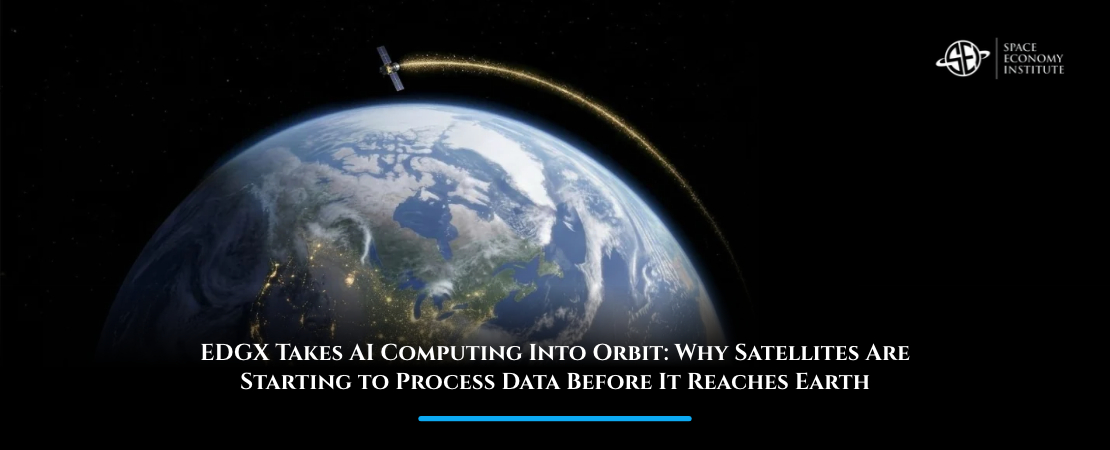
Satellites generate enormous amounts of data. Traditionally, most of that information has had to travel back to Earth before computers could decide what was actually useful.
That model is beginning to change.
Belgian space technology company EDGX announced results from its first in-orbit AI computing demonstrations, using hardware launched aboard SpaceX’s Transporter-16 mission earlier this year. One payload returned operational data within two weeks, and EDGX already has two further missions booked for 2027.
The development points toward a wider transformation: satellites are increasingly becoming computing platforms, not simply sensors in space.
Moving Intelligence Closer to the Data
Consider an Earth-observation satellite photographing thousands of kilometres of the planet.
Under the traditional model, the spacecraft captures images, stores them and waits until it can communicate with a ground station. The data is then transmitted to Earth, processed in a data centre and finally converted into information a customer can use.
Every step takes time and bandwidth.
Onboard AI, often called edge computing, changes where that processing happens. Instead of sending everything to Earth, the satellite can analyse some of the data itself.
For example, an AI model could identify whether an image contains clouds, detect signs of a wildfire or identify a ship before deciding what information needs to be transmitted.
ESA is already testing this principle through missions such as Φsat-2, which uses onboard AI to process imagery in orbit and transmit only the most relevant information to Earth.
The satellite effectively moves from collecting data to interpreting it.
Why Processing Data in Orbit Has Economic Value
The first advantage is speed.
For applications such as wildfire detection, maritime surveillance or disaster response, an image may lose much of its value if the customer receives the insight hours after the event.
Processing information directly aboard the satellite can reduce the time between observation and decision.
The second advantage is bandwidth.
Satellites cannot continuously transmit unlimited amounts of information to Earth. Communications capacity is finite, and transmitting large volumes of raw data requires ground infrastructure, spectrum and energy.
If an AI system can discard unusable imagery or transform a massive dataset into a small alert, the operator needs to send much less information.
ESA projects investigating onboard computing are therefore focused not only on autonomy, but on converting large volumes of satellite data into smaller, immediately useful information products while still in orbit.
That can improve the economics of the entire data chain.
From Satellite Hardware to Compute-as-a-Service
EDGX’s strategy introduces another interesting business model.
Its Sterna computer uses NVIDIA’s Jetson technology to run AI applications aboard satellites. But EDGX is not only planning to sell computers to satellite manufacturers. The company says it is also developing a compute-as-a-service model, allowing customers to upload software and purchase computing capacity already available in orbit. Its first customers have already signed up.
The comparison with cloud computing on Earth is useful.
A company does not necessarily build its own data centre every time it needs more computing capacity; it can rent computing resources from providers such as AWS or Microsoft Azure.
A similar model could eventually develop in space.
Companies could deploy applications onto shared orbital computing infrastructure, process satellite data closer to where it is generated and pay for the computing resources they use.
NVIDIA is also moving aggressively into this market, developing computing platforms specifically for orbital AI, geospatial intelligence and autonomous spacecraft operations.
Smarter Satellites Could Change the Space Value Chain
There are still significant constraints.
Computers operating in space face radiation, strict power limits and difficult thermal conditions. Powerful AI processors consume energy and generate heat, while spacecraft have limited capacity to dissipate that heat.
This means orbit will not simply replace terrestrial data centres.
Instead, the emerging model is likely to divide computing between space and Earth: urgent or data-intensive decisions happen close to the sensor, while larger and less time-sensitive workloads remain on the ground.
That distinction matters economically.
As satellites become more intelligent, value can shift from simply manufacturing sensors and selling raw imagery toward software, AI models, processing capacity and real-time information services.
When Satellites Become Computing Infrastructure
EDGX’s announcement represents a relatively small demonstration, but the direction is significant.
Future satellites may increasingly decide what information matters, coordinate with other spacecraft and deliver answers rather than raw datasets. For Earth observation, defence, communications and autonomous space operations, that could shorten response times while reducing dependence on ground infrastructure.
The result is another expansion of the space economy: from satellites that collect information to an emerging market for computing and intelligence in orbit.
If this topic interests you, the Master in Space Economy by the Space Economy Institute explores how AI, satellite data, emerging infrastructure and new business models are reshaping the global space sector. Discover more about the Master and the economic opportunities developing across the space value chain.