
Zero Industries Raises $3 Million for an Orbital Power Grid: Why Satellites May One Day Buy Electricity in Space
- October 26, 2026
- Posted by: admin
- Category: Uncategorized
Every satellite needs electricity. Today, that usually means carrying its own solar panels and batteries from launch until the end of the mission.
A new startup wants to challenge that model.
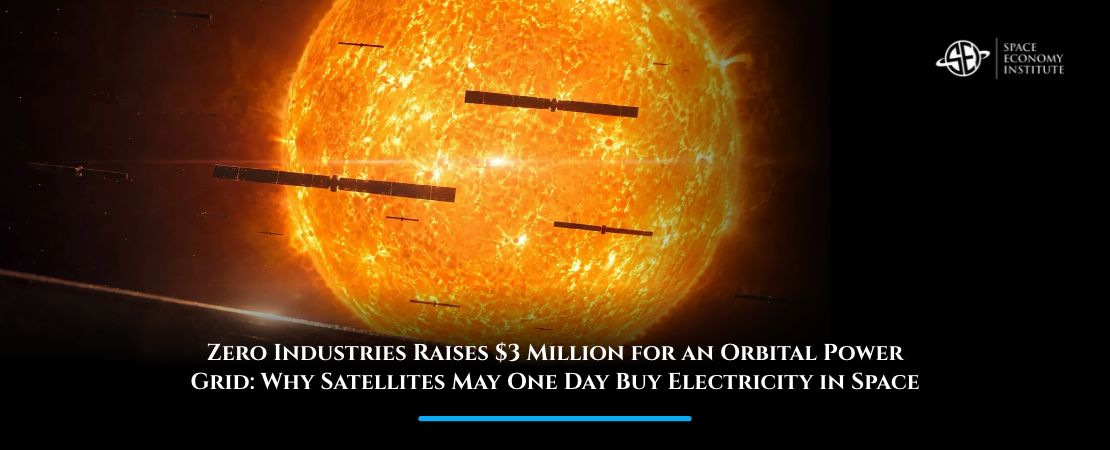
Zero Industries has raised $3 million in pre-seed funding to develop Helios, a proposed system that would generate solar electricity in orbit and transmit it by laser to other spacecraft. The company plans ground demonstrations through 2027 and is targeting its first satellite-to-satellite power transmission demonstration for 2030.
The idea remains highly experimental. But it points toward a larger space-economy question: could electricity eventually become a service that spacecraft buy in orbit?
Why Power Is a Constraint on Satellite Design
A satellite cannot simply plug into an electrical grid.
Most spacecraft generate electricity through solar arrays and store part of it in batteries. Those systems have to be designed, manufactured and launched together with the satellite itself.
That creates trade-offs.
Larger solar arrays can generate more electricity, but they also add mass and complexity. Batteries are needed when a spacecraft passes through Earth’s shadow, while some missions require significant power for sensors, onboard computing, communications or propulsion.
Every kilogram allocated to the power system is therefore a kilogram that cannot be used for another payload.
Zero Industries’ proposed model is based on a different assumption: rather than making each satellite completely self-sufficient, some electricity could be supplied from external infrastructure already in orbit.
From Self-Contained Satellites to an Orbital Power Grid
The proposed Helios system has three main elements.
A Helios Beam satellite would collect solar energy and convert it into laser light. A receiving module called Helios Cell, installed on a customer’s spacecraft, would convert that laser energy back into electricity. Software called Helios Grid would decide when and where power should be delivered and measure how much electricity each customer receives.
Conceptually, this starts to look less like a conventional satellite product and more like a terrestrial utility.
A spacecraft operator would not necessarily need to maximize its own power-generation capacity. Instead, it could potentially purchase additional energy when required.
Early target customers identified by Zero include Earth-observation satellites, orbital transfer vehicles and spacecraft used to inspect or service other satellites. Longer-term applications could include orbital factories and space-based data centers.
The business model would therefore be based not only on selling hardware, but on selling energy as an orbital service.
Why External Power Could Create Economic Value
The potential advantage is flexibility.
Imagine an Earth-observation satellite carrying a powerful radar instrument or advanced onboard AI processors. Both may require substantial electricity. If external power allows the operator to reduce the mass devoted to solar panels and batteries, that capacity could potentially be reassigned to sensors, computing or propulsion.
Power could also be delivered when a spacecraft temporarily needs more energy than its normal systems can provide.
This becomes more interesting as space infrastructure grows.
Orbital transfer vehicles, servicing spacecraft, manufacturing platforms and future data centers could all have significant energy requirements. If every asset must build an entirely independent energy system, power infrastructure is repeatedly duplicated.
A shared network could—in principle—allow generation and consumption to become separate parts of the space value chain.
That is a familiar pattern on Earth. Factories generally do not build their own power plants; they connect to infrastructure developed by specialized energy providers.
The question is whether the same economic logic can eventually work in orbit.
The Technology Still Has to Prove the Economics
Laser power transmission is technically possible, but efficiency remains a major challenge.
In a 2025 terrestrial demonstration, NTT and Mitsubishi Heavy Industries transmitted a one-kilowatt laser over one kilometre and recovered 152 watts of usable electricity, equivalent to about 15% efficiency under difficult atmospheric conditions.
Space removes atmospheric turbulence, but an orbital system introduces other problems: extremely precise pointing, conversion losses, thermal management, spacecraft movement and the mass and cost of the transmitting infrastructure itself.
Zero Industries explicitly says commercial viability will depend on how much usable electricity ultimately reaches customers after accounting for transmission losses, equipment mass and operating costs.
That distinction is crucial. A technology can work technically without making economic sense.
If adding a larger solar array remains cheaper than buying external electricity, operators will have little reason to change.
Building Infrastructure Before the Market Exists
The $3 million investment in Zero Industries is small compared with major satellite programmes, but the concept illustrates how the space economy is evolving.
As activity in orbit expands, companies are increasingly looking beyond rockets and satellites toward the infrastructure between them: transportation, servicing, computing, communications—and potentially energy.
If orbital power transmission becomes commercially viable, future spacecraft could be designed less like isolated machines and more like customers connected to shared infrastructure.
That would represent a significant shift: from every satellite carrying everything it needs to an orbital economy where specialized providers sell essential services to one another.
If this topic interests you, the Master in Space Economy by the Space Economy Institute explores how emerging technologies, infrastructure, investment and new business models interact to create entirely new markets in space. Discover more about the Master and the economic forces shaping the next generation of the global space industry.