
Eutelsat Backs ClearSpace’s Phoenix: Why Extending a Satellite’s Life Could Become a New Space Business
- October 22, 2026
- Posted by: admin
- Category: Uncategorized
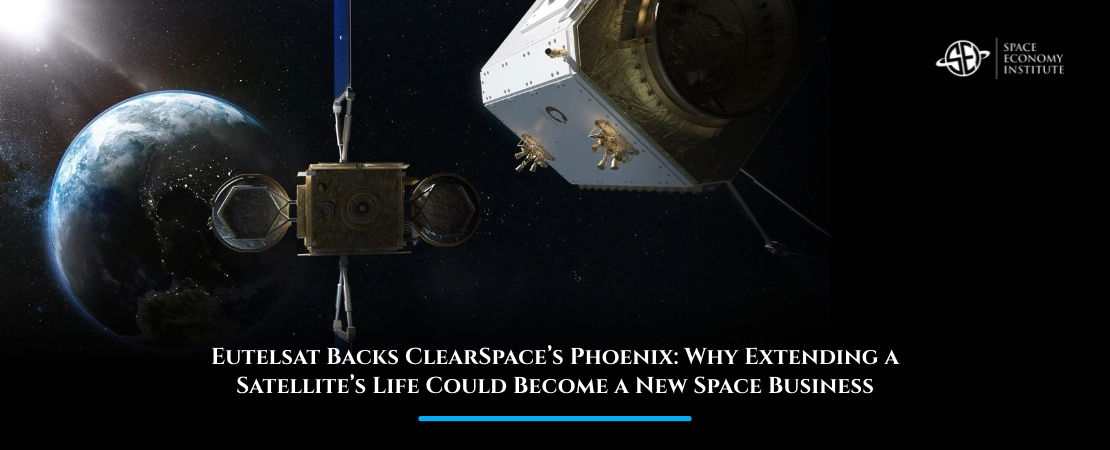
What if satellites could be maintained in orbit instead of simply replaced?
On October 21, ClearSpace and satellite operator Eutelsat signed an agreement to cooperate on Phoenix, a mission designed to extend the operational life of satellites in geostationary orbit. The companies will work together on the technical and commercial requirements for the service, with a Eutelsat satellite potentially becoming the target of an in-orbit demonstration.
The agreement points toward a potentially important new segment of the space economy: servicing satellites after they have already been launched.
Why a Working Satellite Can Still Reach the End of Its Life
Geostationary satellites operate roughly 36,000 kilometres above Earth, where they appear fixed over the same point on the planet. This makes them particularly valuable for communications, television broadcasting and weather services.
But satellites do not simply remain in position automatically.
They need propulsion for small manoeuvres known as station-keeping, which keep them in the correct orbital slot, and for attitude control, which ensures antennas, solar panels and instruments remain properly oriented.
Eventually, that propellant runs out.
The important point is that the satellite itself may still work perfectly well. Its communications payload, electronics and power systems may remain operational, but without sufficient propulsion the operator can no longer reliably control the spacecraft.
Traditionally, that means retiring the satellite and launching a replacement.
In-orbit servicing proposes a different model.
The Economics of Giving Satellites a Second Life
Phoenix is being designed to rendezvous with an existing satellite, dock with it and provide additional propulsion and attitude-control capability.
In practice, the servicing spacecraft would act almost like an external support system, allowing the client satellite to remain operational for longer. ClearSpace says the architecture is being developed to work even with satellites that were not originally designed to be serviced.
That creates a simple economic question.
Suppose an operator has already invested heavily in manufacturing, launching and operating a satellite that continues to generate revenue. If paying for a servicing mission costs less than the economic value of several additional years of operation, extending the asset’s life can make financial sense.
The alternative may require building another satellite, purchasing a launch and waiting for replacement capacity to reach orbit.
For operators, life extension could therefore offer more than additional revenue. It can provide flexibility in fleet planning, allowing companies to delay replacement investment, maintain services longer or bridge the gap until a new generation of satellites is ready.
Eutelsat says this is precisely the potential it wants to explore with ClearSpace: making greater use of assets already in orbit while gaining more options over how its GEO fleet evolves.
From Spacecraft Sales to Spacecraft Services
The wider significance is that in-orbit servicing could change the traditional satellite business model.
Historically, most spacecraft have been treated as relatively disposable assets: manufacture them on Earth, launch them, operate them for a defined lifetime and eventually retire them.
Servicing introduces the possibility of a much more circular model.
A future operator could pay another company to inspect a satellite, move it, extend its life, dispose of it safely or eventually even refuel, repair or upgrade it.
That means new revenue opportunities can emerge after launch, rather than the commercial relationship effectively ending once the spacecraft reaches orbit.
ESA sees this as an emerging commercial market. In September, the agency signed a contract with ClearSpace to advance Phoenix under its ARTES programme, while another European project, D-Orbit’s RISE mission, is also developing GEO life-extension services. A recent ESA industry workshop brought together executives from 20 major satellite operators to assess demand for such capabilities.
The challenge is turning individual demonstrations into a repeatable service at a price operators are willing to pay.
A New Layer of the Space Economy
Phoenix’s wider development programme is estimated at around €100 million, with its first demonstration targeted for 2030. If successful, ClearSpace plans to use the mission as the foundation for commercial GEO servicing in the early 2030s.
The opportunity extends beyond life extension. The same core capabilities—autonomous navigation, rendezvous, docking and control—can support satellite inspection, debris removal and other future in-space operations.
This is why in-orbit servicing could represent an important transition for the space industry: from an economy focused largely on building and launching new assets toward one that also maintains and manages infrastructure already in space.
For satellite operators, that could mean extracting more value from expensive assets. For governments, it could improve the resilience and sustainability of critical orbital infrastructure. And for companies like ClearSpace, it creates an entirely new category of service.
From Disposable Satellites to an In-Orbit Service Economy
The ClearSpace–Eutelsat agreement is therefore significant not just because one satellite may operate for a few additional years, but because it tests whether satellite maintenance itself can become a scalable business.
If operators begin treating spacecraft as assets that can be serviced rather than simply replaced, a new market could emerge around maintaining infrastructure already in orbit.
If this topic interests you, the Master in Space Economy by the Space Economy Institute explores emerging space business models, satellite markets, investment, sustainability and the technologies reshaping the global space sector. Discover more about the Master and the economic opportunities developing across the space value chain.