
NASA Moves Beyond the ISS: What Is a Commercial Space Station and Who Will Use It?
- October 12, 2026
- Posted by: admin
- Category: Uncategorized
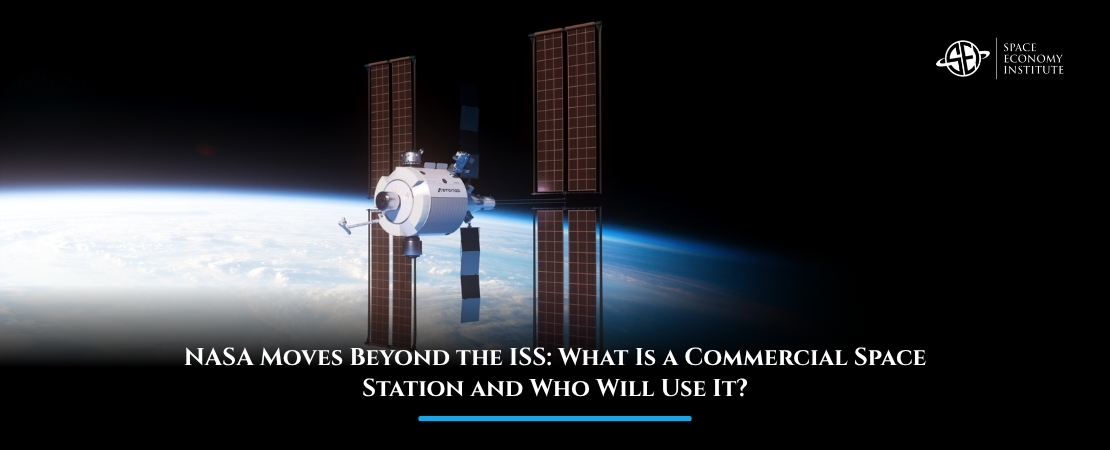
NASA is preparing for a future without the International Space Station—and the replacement may work very differently from the ISS itself.
On October 9, NASA released its final Request for Proposals, or RFP, inviting companies to compete for contracts to develop the next generation of commercial space stations in low Earth orbit. Proposals are due December 8, with awards expected in spring 2027.
The important change is not simply technological. It is economic. Rather than building and operating another government-owned station, NASA wants to purchase services from privately operated destinations.
That raises two questions at the heart of the emerging low Earth orbit economy: what exactly is a commercial space station—and who, besides NASA, will pay to use one?
What Makes a Space Station “Commercial”?
The easiest comparison is the International Space Station.
The ISS is essentially government infrastructure. NASA and its international partners funded its development, operate it and use it for scientific research, astronaut training, technology demonstrations and other public objectives.
A commercial space station reverses that relationship.
A private company develops and operates the station, while different customers pay to use its infrastructure and services. NASA could buy laboratory capacity or accommodation for astronauts, but so could another government, a pharmaceutical company, a university or a technology business.
NASA therefore wants to move from being primarily the owner of the infrastructure to one of its customers—much as an airline buys airport services without owning the airport itself.
This does not mean NASA is leaving low Earth orbit. The agency says it still needs orbital facilities for research, crew training, technology development and preparation for missions to the Moon and Mars. What changes is who owns and operates those facilities.
Why Would Anyone Pay to Work in Orbit?
A commercial space station is not simply a privately owned ISS—or an orbital hotel.
Its economic value begins with the unusual environment it provides.
Space stations operate in low Earth orbit (LEO), the region relatively close to Earth where spacecraft continuously fall around the planet. This produces microgravity: the near-weightless environment experienced by astronauts.
Microgravity can change how fluids behave, how biological systems develop and how materials form. That makes orbit potentially valuable for research that is difficult to reproduce on Earth.
One practical example comes from pharmaceuticals. Research conducted by Merck on the ISS examined how proteins crystallize in microgravity. The experiments produced insights that contributed to the development of a new injectable formulation of pembrolizumab, used in cancer treatment. The new formulation was approved by the U.S. Food and Drug Administration in 2025.
Research in orbit is also exploring biotechnology, advanced materials, semiconductors, tissue engineering and other areas.
Commercial interest already exists. In fiscal year 2025, the ISS National Laboratory delivered a record 115 sponsored payloads to the station, with nearly 80% involving commercial research projects.
The question is whether that demand can eventually become large enough to help support private orbital infrastructure.
Who Could Become the Customers?
The potential market extends beyond traditional aerospace companies.
Pharmaceutical and biotechnology companies could buy research capacity. Advanced manufacturers could investigate whether high-value materials can be produced differently in microgravity. Technology companies could test computing systems, robotics or other hardware in orbit.
Governments could become customers too.
Countries interested in human spaceflight do not necessarily need to build their own space stations. They could instead purchase astronaut training, transportation, research time and missions from commercial providers.
Axiom Mission 4 offered an early glimpse of this model. The privately operated mission brought astronauts representing India, Poland and Hungary to the ISS for scientific, educational and commercial activities.
Universities, research institutions and private astronaut missions could create additional demand.
The long-term vision is therefore not a station supported by one government, but orbital infrastructure serving multiple customers with different reasons for going to space.
The Anchor-Customer Problem
There is an obvious difficulty: somebody has to build the station before most of those customers can use it.
Human-rated orbital infrastructure requires enormous investment. But investors are reluctant to fund infrastructure without proven demand, while customers cannot purchase services from infrastructure that does not yet exist.
This is where NASA becomes strategically important as an anchor customer.
An anchor customer is a large, credible first buyer whose commitment gives a new market enough predictable demand to begin developing.
NASA has used this logic before. Through its commercial crew programme, private companies developed and operate spacecraft while NASA purchases astronaut transportation as a service. NASA describes this approach as allowing commercial providers to focus on transportation in low Earth orbit while the agency directs more resources toward deep-space exploration.
The same principle is now being extended from spacecraft to space stations.
NASA plans to award contracts to multiple providers during the early development phase, preserving competition before selecting providers for later design, testing, certification and services. The contracts will be firm-fixed-price: rather than simply reimbursing whatever a project costs, NASA agrees to pay defined prices for contracted work.
The broader economic mechanism is straightforward:
NASA creates initial demand → private investment becomes less risky → companies build infrastructure → additional customers can enter → a new market has a chance to emerge.
NASA Can Start the Market—but It Cannot Be the Market
This is where the distinction between a government programme and a true commercial market becomes important.
If NASA remains responsible for most of a station operator’s revenue indefinitely, the station may be privately operated, but its underlying market would still depend heavily on government.
For the commercial model to work at scale, operators need customers beyond NASA.
NASA Administrator Jared Isaacman made that requirement explicit when announcing the new procurement: companies need credible plans for destinations that can serve NASA while developing additional customers and markets of their own. As he put it, “the economics ultimately have to work.”
That makes the post-ISS transition more than a competition over which company can build the best station. It is a test of whether enough demand exists to create a sustainable low Earth orbit economy.
And the economic impact would extend far beyond station operators. Commercial destinations require launch services, spacecraft, life-support systems, communications, robotics, docking technologies, insurance, training, ground operations and a broad network of suppliers.
From a Space Station to a Space Market
NASA’s October procurement therefore represents something larger than the search for an ISS replacement.
It is an attempt to move low Earth orbit from a model dominated by government-owned infrastructure toward one where governments, companies and research institutions purchase services from competing commercial providers.
Whether that transition succeeds remains uncertain. The U.S. Government Accountability Office has warned that questions remain around both the readiness of commercial stations and the development of sufficient demand beyond NASA.
But that uncertainty is precisely what makes the next few years so important for the space economy. If NASA can use institutional demand to help private infrastructure emerge—and operators can then attract pharmaceutical companies, other governments, researchers and entirely new customers—commercial space stations could become more than replacements for the ISS.
They could become the foundation of a genuine orbital marketplace.
If this topic is of interest, the Master in Space Economy by the Space Economy Institute explores how institutional demand, public-private partnerships, investment, technology and emerging business models interact to create new space markets. Discover more about the Master and the economic forces shaping the next phase of the global space industry.