
Astranis Secures $468M EXIM Financing: Sovereign Satellite Demand Drives Space Manufacturing
- September 30, 2026
- Posted by: admin
- Category: Uncategorized
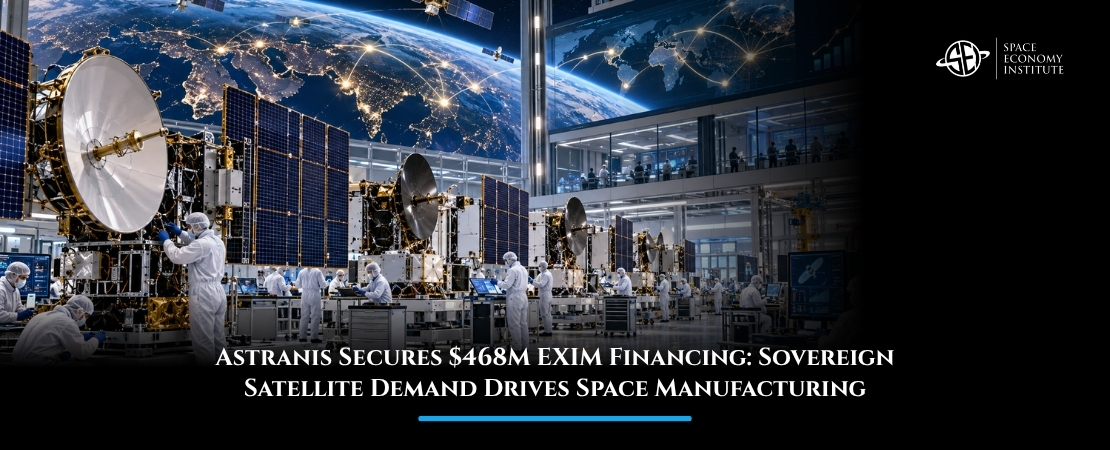
Satellite Manufacturing Is Becoming Industrial Policy
Commercial satellite production is attracting a new kind of capital. On September 30, Astranis announced that the U.S. Export-Import Bank approved a $468 million credit facility to support domestic satellite manufacturing, launch costs and related infrastructure. The financing comes as governments and telecom operators increasingly seek dedicated, secure satellite networks—turning sovereign connectivity into both a commercial opportunity and a strategic priority.
What the $468 Million Financing Actually Means
The transaction is not a government grant or equity investment. It is a large credit facility backed through EXIM, the United States’ official export credit agency.
Federal documentation shows the financing is intended to cover components used in domestic satellite production as well as associated launch and insurance costs, ultimately supporting satellite telecommunications services.
This distinction matters. Space companies often face a financing problem between technological success and industrial scale. Building a prototype satellite may be funded through venture capital, but fulfilling a growing order book requires factories, components, launch commitments, insurance and working capital long before customers receive operational services.
Export-credit financing can help bridge that gap.
For Astranis, the new facility follows a $450 million financing package announced in May, including a $300 million Series E, as the company expands production for commercial and U.S. government customers.
The broader signal is clear: space companies are increasingly assembling capital stacks that combine venture equity, private credit and government-supported financing rather than relying on venture capital alone.
Why Astranis Is Betting on Smaller GEO Satellites
Astranis is taking a different approach from companies building thousands of satellites in low Earth orbit.
Its MicroGEO satellites operate in geostationary orbit, where a spacecraft remains positioned over roughly the same region of Earth. Traditional GEO communications satellites can weigh several tonnes and require years to manufacture. Astranis is developing much smaller spacecraft intended to offer dedicated capacity with shorter manufacturing cycles.
The company currently has five satellites in orbit, employs roughly 500 people and operates from a 153,000-square-foot manufacturing headquarters in California. It also reports a commercial backlog exceeding $1 billion.
The economic proposition is especially attractive to countries and telecom companies that do not necessarily need an enormous multi-billion-dollar constellation but want control over their own communications infrastructure.
Instead of purchasing capacity from a large shared satellite, a customer can have a dedicated spacecraft configured around its own geographic coverage, networking requirements and security priorities.
The Rise of Sovereign Connectivity
This concept—sovereign satellite connectivity—is becoming an important market.
Earlier this year, Oman’s MB Group selected Astranis for a dedicated MicroGEO satellite as part of a wider investment in national satellite connectivity. More recently, Saudi Arabia’s stc group ordered a dedicated Astranis spacecraft scheduled for the company’s Block 3 launch campaign. Astranis has also announced customers and projects involving Taiwan and Thailand.
The attraction goes beyond broadband coverage.
Governments increasingly view communications networks as critical infrastructure. A dedicated satellite can offer greater control over coverage, network architecture and data management—particularly important for government, defense, emergency communications and nationally sensitive services.
This creates a market between two established extremes: relying entirely on global satellite constellations on one side and developing a sovereign national space program from scratch on the other.
Smaller dedicated GEO satellites could provide a third option.
Export Credit Becomes a Space Economy Tool
Astranis is also part of a larger trend in U.S. industrial policy.
Earlier in September, EXIM signed $280 million in financing for CesiumAstro’s manufacturing expansion in Texas, supporting production of satellite communications systems.
The pattern is significant. Export credit agencies have traditionally been associated with aircraft, energy projects and major infrastructure exports. Their growing involvement in commercial space suggests that satellite manufacturing is increasingly being treated as a strategic export industry.
For governments, these transactions can support domestic factories, supply chains and employment while helping national companies compete internationally. For space businesses, they can unlock hundreds of millions of dollars without requiring founders and existing investors to finance every stage of growth through additional equity.
This is how commercial space starts to resemble a mature industrial sector.
What Comes Next for Satellite Manufacturing
Astranis’s financing matters to satellite manufacturers, telecom operators, governments, investors, suppliers and launch providers. As sovereign connectivity demand grows, competition will increasingly depend not only on spacecraft technology but also on manufacturing capacity and access to large-scale financing.
If this topic is of interest, you can learn more about satellite communications, space finance, manufacturing, institutional markets and commercial space strategy in the Master in Space Economy by the Space Economy Institute. Discover more about the Master and explore how finance and industrial policy are shaping the next phase of the global space economy.