
ESA Digital EO: Europe Builds a Sovereign Cloud for Earth Observation Data
- September 29, 2026
- Posted by: admin
- Category: Uncategorized
The Next Earth Observation Bottleneck Is on the Ground
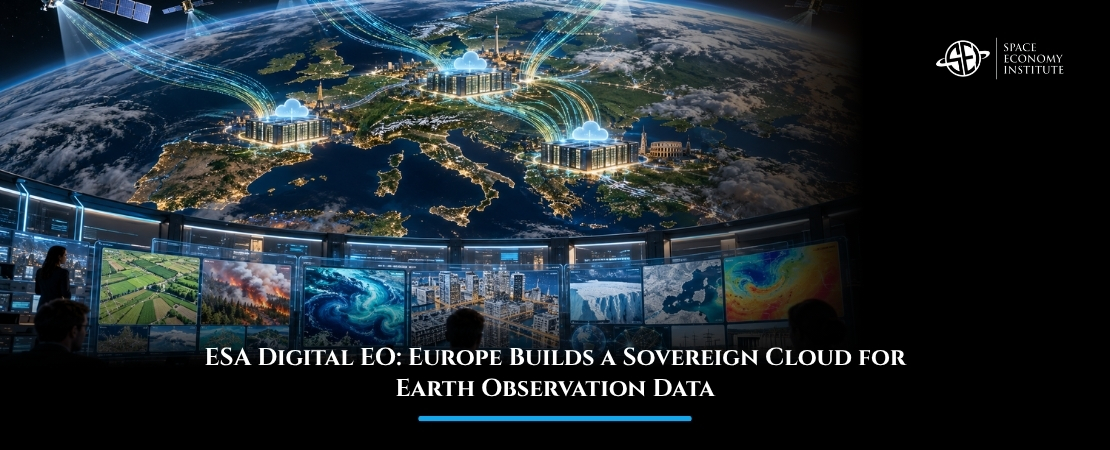
Europe already operates some of the world’s most advanced Earth-observation missions. Now it faces a different challenge: what to do with the enormous amount of data they generate. On September 28, OVHcloud and CGI announced a multi-million-euro, 30-month contract with the European Space Agency to build Digital EO, a new digital infrastructure combining satellite data, cloud computing, storage, and artificial intelligence. ESA expects Earth-observation holdings to exceed 500 petabytes by 2035.
What Is Digital EO?
Digital EO is ESA’s planned Earth Observation Information System. Instead of creating another isolated database, ESA wants a decentralized and scalable environment capable of connecting datasets, computing resources, AI tools, applications, and existing European and national infrastructure.
The distinction is important.
Historically, much of the Earth-observation economy focused on satellites: better sensors, higher resolution, more frequent revisits. But as constellations expand, data management itself becomes infrastructure. Hundreds of petabytes are useful only if scientists, companies, governments, and software developers can efficiently find, process, combine, and analyze them.
Digital EO is intended to make that possible.
OVHcloud will provide the core compute, storage, networking, and managed cloud infrastructure, while CGI will act as system architect and integrator, connecting different data assets, applications, services, and user communities. The initial infrastructure will be deployed across Italy, France, and Germany, with operational support from Poland and the ability to expand further.
Why 500 Petabytes Changes the Economics
A petabyte equals one million gigabytes. More than 500 petabytes therefore represents an enormous archive of satellite observations.
And the challenge is not simply storing it.
Earth-observation users increasingly want decision-ready information: wildfire alerts, crop forecasts, flood maps, infrastructure changes, methane detection, maritime activity, climate indicators, and security intelligence. Producing those outputs requires significant computing power and increasingly relies on machine learning.
This changes where value is created in the space economy.
The satellite may capture the original image, but cloud providers store it. AI companies analyze it. Software businesses combine it with other information. Downstream applications turn it into a product purchased by governments, insurers, farmers, energy companies, financial institutions, or emergency services.
Digital EO is therefore not merely an IT modernization project. It is infrastructure for expanding Europe’s downstream Earth-observation economy.
Copernicus, DestinE and the Rise of AI-Driven Earth Observation
ESA says Digital EO will support major European programs including Copernicus and Destination Earth, or DestinE, the EU initiative developing digital representations of the Earth to support climate adaptation and policy decisions.
This reflects a broader transformation underway in Earth observation.
Europe’s current EO architecture is being challenged by rising demand for timely information, greater use of AI-driven prediction, increasing commercial participation, and a more complex security environment. An ESA workshop taking place this week at ESTEC is specifically examining how Europe’s Earth-observation system may need to evolve between 2040 and 2060, with AI, commercial space, resilience, and data infrastructure among the central issues.
In other words, the future may involve fewer boundaries between satellites, cloud infrastructure, AI models, digital twins, and operational services. They increasingly function as parts of the same information system.
Why Europe Wants a Sovereign Data Layer
The choice of European infrastructure providers also has strategic implications.
Earth-observation data can support agriculture and climate science, but it can also reveal military activity, critical infrastructure, natural-resource conditions, and economic behavior. Where that information is stored and processed therefore matters.
OVHcloud explicitly describes Digital EO as a sovereign European infrastructure, designed to give Europe greater control over the digital systems supporting strategic programs.
This complements other European initiatives. ESA recently awarded ICEYE and Leonardo contracts to design the architecture for the future Earth Observation Governmental Service, a dual-use system intended to strengthen European security, resilience, and autonomy.
Europe is consequently building sovereignty at several layers: satellites in orbit, secure connectivity, launch capacity, and now the digital infrastructure that processes space-derived information.
The Next Layer of the Space Economy
Digital EO matters to satellite operators, AI companies, cloud providers, researchers, governments, insurers, farmers, climate specialists, and companies developing geospatial applications. As satellite data volumes expand, competitive advantage will increasingly depend on who can turn raw observations into trusted information fastest.
If this topic is of interest, you can learn more about Earth observation, satellite data, AI and analytics, European space infrastructure, and downstream space markets in the Master in Space Economy by the Space Economy Institute. Discover more about the Master and explore how digital infrastructure is becoming a critical layer of the global space economy.