
India’s Orbital Computing Satellite: How TakeMe2Space Is Bringing AI Processing to Space
- September 28, 2026
- Posted by: admin
- Category: Uncategorized
The Cloud Is Moving Closer to the Satellites
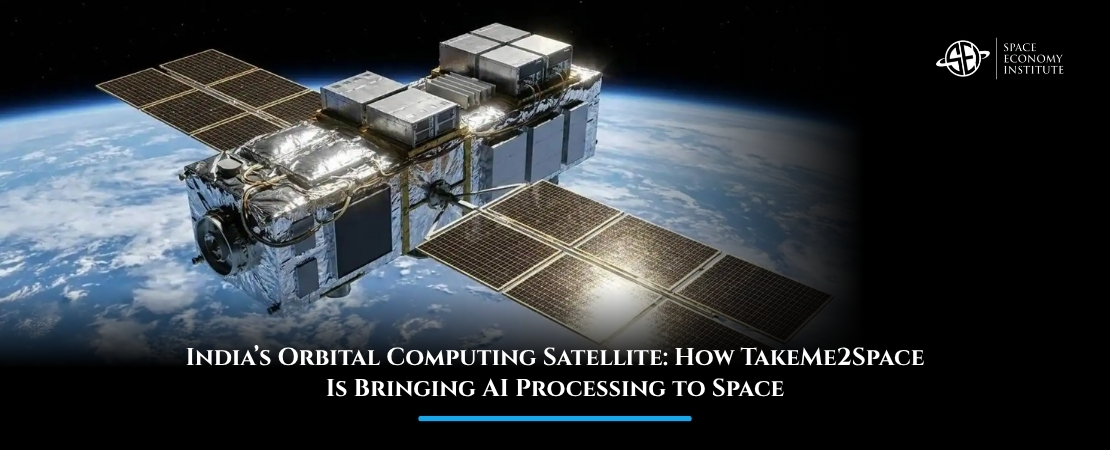
A new layer of digital infrastructure is emerging above Earth. On September 28, Indian startup TakeMe2Space confirmed plans to launch MOI-1A on October 1 aboard SpaceX’s Transporter-18 mission. The company describes it as India’s first orbital-computing satellite. Rather than sending every image to Earth for processing, MOI-1A will run AI models directly in orbit and transmit useful results instead.
Why Process Satellite Data in Space?
Modern Earth observation satellites can generate enormous quantities of data. Traditionally, that information must first be transmitted to ground stations and then moved into terrestrial cloud infrastructure for processing.
That creates a bottleneck.
A satellite may capture valuable imagery over a farm, mine, wildfire, port or disaster zone but have to wait for a ground-station connection before the data can be downloaded. Large raw datasets also consume scarce communications bandwidth.
Orbital edge computing changes the workflow. Instead of sending everything to Earth, software aboard the spacecraft analyzes data where it is generated. The satellite can identify useful information—such as crop stress, infrastructure changes or other anomalies—and transmit a much smaller processed result.
TakeMe2Space says customers will be able to upload containerized AI models to MOI-1A, allowing them to process observations over selected geographic areas in orbit. The company says this can reduce transmission requirements and the costs associated with downloading large volumes of raw imagery.
What Is Actually Inside MOI-1A?
It is important to distinguish MOI-1A from the much larger orbital data centers proposed by companies hoping eventually to operate powerful AI computing infrastructure in space.
MOI-1A is better understood as an edge-computing satellite.
TakeMe2Space lists the spacecraft as a 6U platform weighing about 14 kilograms, equipped with an Nvidia Jetson Orin NX processor capable of 117 TOPS of AI compute, 16 GB of memory and 2 TB of onboard storage. It also carries a nine-band multispectral imaging system.
The combination allows the spacecraft to both capture Earth imagery and analyze it onboard.
This makes MOI-1A a useful test of a different economic model: instead of selling only satellite imagery, an operator can sell compute time in orbit.
TakeMe2Space’s OrbitLab platform already advertises access to satellite computing infrastructure on a usage basis, allowing developers to upload models and experiments rather than owning an entire spacecraft.
There Are Already Paying Customers
Perhaps the most economically significant detail is that MOI-1A is not launching only as a technology demonstration.
TakeMe2Space told Reuters that 23 customers have signed up for the mission, including geographic-information-system companies and educational institutions. Commercial customers span agriculture, mining, supply-chain management and insurance, while U.S. space-data company Little Place Labs is also among the users.
This matters because orbital computing must ultimately prove an economic advantage, not merely technical feasibility.
A mining company could process imagery to identify changes around extraction sites. Agricultural customers could run crop-analysis models. Insurers could monitor environmental events. Supply-chain companies could extract intelligence from ports or transportation infrastructure without waiting for complete datasets to reach terrestrial servers.
The business case is strongest when the value of receiving an answer quickly exceeds the cost of computing it in orbit.
From One Satellite to an Orbital Computing Network
MOI-1A follows an earlier technology-demonstration mission that validated application uploads and AI inference in orbit. Another spacecraft, MOI-1, was subsequently lost during a launch-vehicle third-stage failure. TakeMe2Space now plans larger, networked satellites from 2027, with greater computing capacity and the ability to serve multiple users.
The company is also exploring orbital cold storage for critical data, targeting defense and financial customers seeking geographically—and physically—separate backups from terrestrial cloud infrastructure.
That points toward a broader trend. Satellites are evolving from sensors and communications relays into computing platforms.
What Comes Next for the Space Data Economy
MOI-1A matters to Earth observation companies, cloud providers, AI developers, insurers, farmers, defense agencies and investors. If onboard computing proves cheaper and faster for selected workloads, future satellite networks may increasingly process information before it ever reaches Earth.
If this topic is of interest, you can learn more about space data, Earth observation, artificial intelligence, satellite infrastructure and emerging space business models in the Master in Space Economy by the Space Economy Institute. Discover more about the Master and explore how computing is becoming a new layer of the orbital economy.