
FCC Satellite Spectrum Proposal: Why Space-Based Broadband Needs More Frequencies
- September 9, 2026
- Posted by: admin
- Category: Uncategorized
Spectrum Becomes the New Space Infrastructure
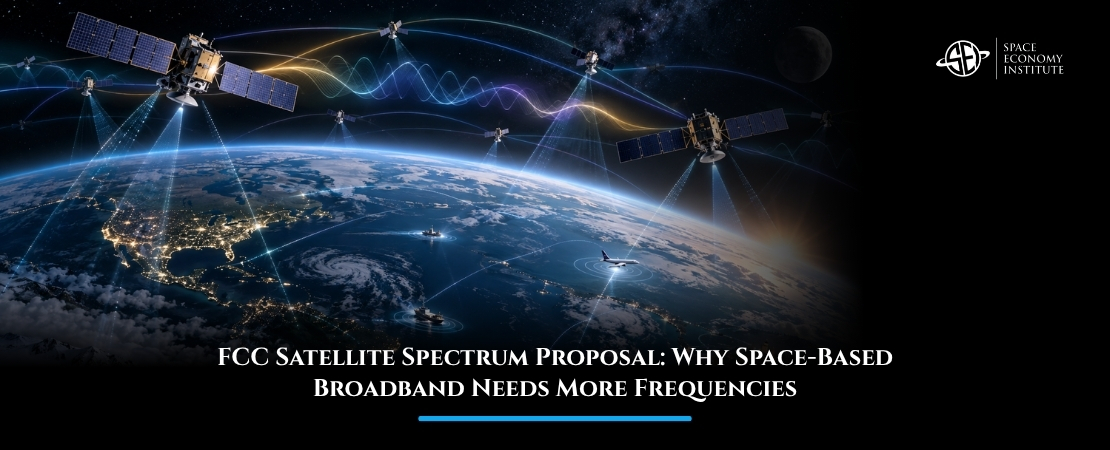
The space economy is not only constrained by rockets, satellites or capital. It is also constrained by spectrum. On September 8, 2026, the U.S. Federal Communications Commission announced a proposal to open more than 1,000 MHz of spectrum in the 12 GHz and 42 GHz bands for space-based broadband services. This is one of the most relevant policy developments for satellite connectivity, because the next generation of space services will depend on access to clean, scalable and well-regulated frequencies.
Why Spectrum Matters in Satellite Communications
Every satellite network depends on radio frequencies to transmit data between satellites, user terminals, ground stations, aircraft, ships and terrestrial networks. Without spectrum, a satellite is just hardware in orbit. With the right spectrum rights, it becomes part of a global communications system.
This is especially important because satellite broadband is moving from niche connectivity to mainstream infrastructure. Low Earth orbit constellations are already serving homes, remote communities, ships, aircraft, emergency responders and government users. Direct-to-device services are beginning to connect ordinary smartphones from space. Satellite operators are also developing optical inter-satellite links, advanced ground networks and hybrid terrestrial-space architectures.
All of this creates pressure on spectrum. More satellites, higher data rates and more users mean more demand for bandwidth. The FCC’s proposal is therefore not a technical footnote. It is a market-shaping decision.
What the FCC Is Proposing
The FCC plans to vote on September 30 on an order that would open more than 1,000 MHz in the 12 GHz and 42 GHz bands for high-speed satellite broadband. The proposal is designed to support several use cases: satellite broadband for homes, in-flight connectivity, on-ship connectivity and traffic-routing functions in satellite ground networks.
The 12 GHz band is valuable because mid-band spectrum can support meaningful capacity while still offering practical propagation characteristics. The 42 GHz band sits higher in the spectrum and can support very high-capacity links, though with greater technical requirements around antennas, signal management and atmospheric effects.
For the commercial space sector, this means more room to build high-throughput services. For users, it could mean faster satellite internet, more resilient connectivity in remote areas, better maritime and aviation communications, and more competitive service options.
The Economic Impact: Capacity, Competition and New Services
Spectrum abundance can unlock business models that would otherwise be limited by congestion. Satellite broadband companies need enough capacity to serve more users without degrading performance. Airlines need reliable high-speed connectivity over oceans and remote routes. Shipping companies need real-time data for navigation, logistics, safety and emissions monitoring. Governments need resilient communications during disasters or conflicts.
More spectrum can also increase competition. If only a few operators have access to the best frequencies, market concentration becomes harder to challenge. A broader and clearer spectrum framework can help new entrants, established satellite operators, telecom companies, equipment manufacturers and ground infrastructure providers plan investments with more confidence.
The FCC has already been moving in this direction. Earlier this year, it eased power limits on satellite spectrum use, a decision expected to support more intensive use of wireless spectrum for space activities and potentially generate around $2 billion in economic benefits through increased broadband usage.
The Regulatory Challenge
Opening spectrum is not as simple as declaring it available. Regulators must manage interference, coordinate terrestrial and satellite users, protect incumbent services, support national security needs and ensure fair access.
This is where spectrum policy becomes industrial policy. The countries that create clear, technically credible and innovation-friendly frameworks will attract satellite operators, ground system investment, user equipment development and downstream service providers. The countries that move too slowly may find themselves dependent on foreign infrastructure and foreign regulatory decisions.
The FCC’s move also reflects a larger global reality: space-based connectivity is becoming part of national digital infrastructure. Spectrum is no longer just a telecom issue. It is a space economy asset.
What Comes Next
The FCC’s satellite spectrum proposal affects satellite operators, telecom companies, airlines, maritime firms, equipment manufacturers, rural users, investors, regulators and national security agencies. If approved, it could accelerate the transition from satellite broadband as a specialized service to satellite connectivity as a normal layer of global communications.
If this topic is of interest, you can learn more about satellite communications, spectrum policy, telecom-space convergence and commercial space strategy in the Master in Space Economy by the Space Economy Institute. Discover more about the Master and explore how spectrum is shaping the future of the global space economy.