
Paris Space Summit 2026: Europe’s Fight for Space Sovereignty and Launch Autonomy
- September 8, 2026
- Posted by: admin
- Category: Uncategorized
Europe Puts Space Sovereignty on the Global Stage
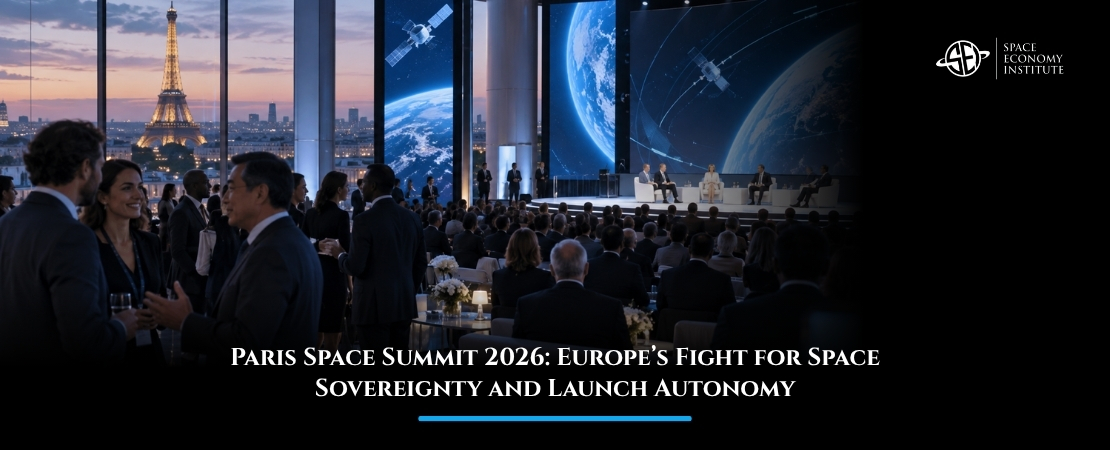
Europe’s space ambitions are moving into the political spotlight. On September 9–10, 2026, France will host the International Space Summit in Paris, led by President Emmanuel Macron and attended by around 2,000 delegates from government, industry, and space institutions. The timing is critical. Europe is trying to define its role in a space economy increasingly shaped by U.S. commercial dominance, Chinese state-backed expansion, defense demand, and the urgent need for autonomous access to orbit.
Why This Summit Matters
The Paris summit is not expected to produce major binding decisions, but its political meaning is significant. It places space at the center of Europe’s strategic agenda.
For years, Europe has had world-class space science, strong satellite manufacturers, advanced Earth observation programs, and major institutional actors such as ESA, EUMETSAT, the European Commission, CNES, ASI, DLR, and national space agencies. Yet Europe still faces a structural challenge: it remains fragmented compared with the United States and China.
The U.S. benefits from massive defense demand, deep private capital markets, and vertically integrated companies such as SpaceX. China benefits from state coordination, industrial scale, and long-term strategic planning. Europe has technical excellence, but often struggles with slower procurement, divided national priorities, limited risk capital, and weaker launch cadence.
The Paris summit is therefore a signal: Europe knows that space is no longer only a scientific or industrial sector. It is strategic infrastructure.
Launch Autonomy Is the Core Issue
One of the most important themes is autonomous access to space. Europe has spent the past few years rebuilding its launch position after the end of Soyuz access, delays in Ariane 6, and pressure from SpaceX’s lower-cost, high-cadence launch model.
Ariane 6 and Vega-C remain central to Europe’s institutional launch strategy, but the market is changing quickly. Satellite constellations, defense systems, Earth observation networks, secure communications, and lunar missions all require reliable, frequent, and affordable launch options.
The recent success of Isar Aerospace’s Spectrum rocket from Norway strengthened the case for Europe’s commercial launch ecosystem. But one successful launch does not solve the broader challenge. Europe needs a complete launch portfolio: heavy launch, medium launch, small launch, responsive launch, and competitive spaceports.
Without that, even the strongest satellite strategy remains exposed.
The Satellite Sovereignty Question
The summit also comes as Europe accelerates major satellite infrastructure programs. The most visible example is IRIS², the EU’s secure connectivity constellation designed to provide resilient satellite communications for governments, defense users, emergency services, and critical infrastructure.
IRIS² is not simply a telecom project. It is Europe’s answer to a world where satellite networks increasingly influence warfare, disaster response, maritime security, aviation, digital government, and industrial resilience.
The broader question is whether Europe can build and operate strategic satellite infrastructure without depending too heavily on non-European providers. This does not mean cutting ties with global partners. It means ensuring that essential communications, navigation, observation, and security capabilities remain available under European governance.
Regulation, Competition and the Private Sector
The Paris summit is also expected to focus on space regulation, traffic management, and rules for a more crowded orbital environment. This matters because the next space economy will involve more satellites, more launches, more reentries, more dual-use systems, and more commercial operators.
Europe has an opportunity to lead in responsible space governance, but regulation must not become a substitute for competitiveness. The challenge is to build rules that protect sustainability and security while still allowing companies to scale.
This is where Europe must be honest. It needs stronger private investment, faster procurement, more support for scaleups, and a clearer path for commercial operators to sell into institutional and defense markets. Sovereignty is not achieved by declarations alone. It is built through contracts, factories, launch pads, satellites, software, and skilled workers.
What Comes Next for Europe’s Space Economy
The Paris Space Summit affects governments, satellite manufacturers, launch companies, investors, defense agencies, regulators, startups, and downstream users of space services. Its real value will depend on whether it turns political urgency into industrial execution.
Europe has the talent, institutions, and market need to compete. The next test is whether it can move fast enough.
If this topic is of interest, you can learn more about European space policy, launch autonomy, satellite infrastructure, public-private partnerships, and commercial space strategy in the Master in Space Economy by the Space Economy Institute. Discover more about the Master and explore how space sovereignty is shaping the future of the global space economy.