
Isar Aerospace Spectrum Launch: Europe’s First Commercial Rocket Reaches Orbit
- September 7, 2026
- Posted by: admin
- Category: Uncategorized
Europe Gets a New Launch Milestone
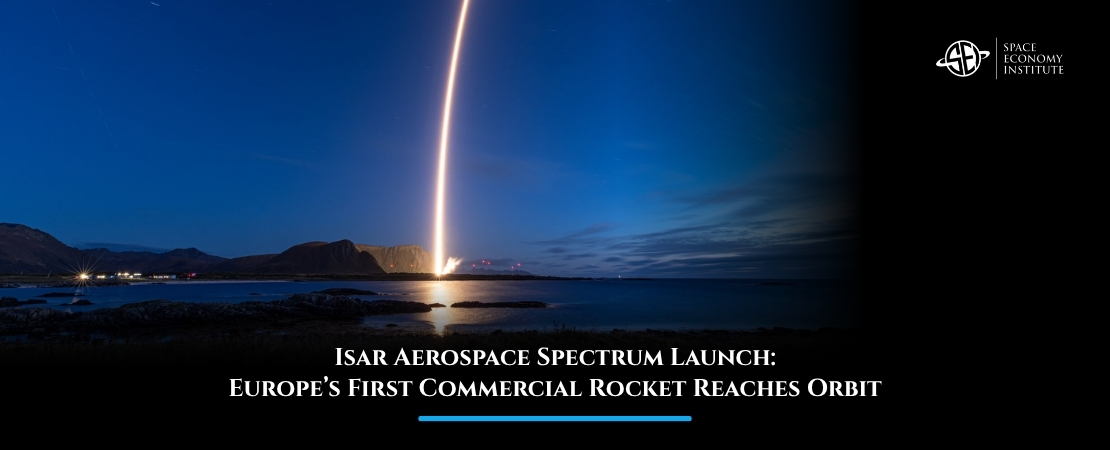
Europe’s commercial launch sector has just crossed a historic threshold. On September 5, 2026, German startup Isar Aerospace successfully launched its Spectrum rocket from Andøya Spaceport in northern Norway, reaching orbit and deploying payloads on only its second flight. The mission is one of the most important space economy stories of the week because it gives Europe a privately developed orbital launcher from continental Europe.
Why This Launch Matters
For years, Europe’s access to orbit has depended mainly on institutional launch systems such as Ariane and Vega. Those vehicles remain central to European space strategy, but the market is changing. Satellite operators increasingly need more launch options, more flexible schedules, and more competitive prices.
Isar Aerospace’s successful Spectrum mission is important because it shows that Europe’s private launch ecosystem is beginning to mature. The company became the first commercial space company from Europe to successfully deliver satellites into orbit, according to Isar’s own mission update. ESA also described the flight as the first launch to orbit from continental Europe by a European commercial company.
That distinction matters. Europe is not only trying to launch more satellites. It is trying to build an industrial base that can compete in a global market shaped by SpaceX, Chinese launch providers, and new entrants from India, the United States, and elsewhere.
From Failure to Orbit
The achievement is also notable because it followed an earlier failed test flight. In March 2025, Isar’s first Spectrum launch attempt ended unsuccessfully. That is not unusual in launch development. Rockets are complex systems, and early failures are part of the path toward operational capability.
What matters economically is whether a company can learn, iterate, finance the next attempt, and return to flight. Isar did exactly that. Reaching orbit on the second flight strengthens its credibility with customers, investors, governments, and insurers.
Reuters reported that Spectrum launched from Arctic Norway and marked a breakthrough for Europe’s independent access to space. The Verge similarly framed the mission as Europe’s first entirely commercial orbital rocket. For a launch company, credibility is not built by ambition alone. It is built by flight data.
The Market Need: Europe’s Launch Bottleneck
This milestone arrives at exactly the right moment. Europe is facing a growing launch capacity challenge. ESA is considering increasing the launch rate of Ariane 6 and Vega-C to address expected satellite deployment bottlenecks, while ArianeGroup is studying how to raise Ariane 6 launch frequency beyond current plans.
Arianespace aims to reach a steady rate of nine to ten Ariane 6 launches per year by 2027, but further growth depends on solving supply-chain constraints, including solid propellant production. ArianeGroup has said discussions involve roughly 600 supplier companies, showing how complex launch scaling really is.
This is where smaller private launchers become strategically useful. Spectrum is not a replacement for Ariane 6. It serves a different market: small and medium satellites that need dedicated, flexible access to low Earth orbit. If Europe can combine heavy launch, medium launch, and responsive small launch, it can reduce dependence on foreign providers and offer customers a more complete launch ecosystem.
Launch Autonomy Is Economic Autonomy
Launch autonomy is often discussed as a political or defense issue, but it is also an economic issue. Without reliable access to orbit, satellite manufacturers, Earth observation companies, telecom operators, defense agencies, and research institutions face delays and external dependencies.
The war in Ukraine, the loss of Russian launch options, and SpaceX’s dominance have all pushed Europe to rethink launch resilience. Private companies such as Isar Aerospace, Rocket Factory Augsburg, PLD Space, HyImpulse, and Maiaspace are now part of the answer.
Isar’s Spectrum success also strengthens the case for programs such as ESA’s Boost! initiative and the European Launcher Challenge, which support commercial space transportation services. ESA noted that this second Spectrum flight completes the first milestone of the European Launcher Challenge, reinforcing the link between public support and private execution.
What Comes Next for Europe’s Space Economy
Isar Aerospace’s orbital success affects satellite operators, launch customers, investors, European governments, spaceports, suppliers, and defense planners. The mission does not solve Europe’s launch challenge overnight, but it proves that commercial European launch is no longer theoretical.
If this topic is of interest, you can learn more about launch markets, European space autonomy, satellite deployment strategy, and commercial space infrastructure in the Master in Space Economy by the Space Economy Institute. Discover more about the Master and explore how access to orbit is shaping the future of the global space economy.