
Commercial Space Supply Chains: Why Industrial Capacity Is the Next Space Economy Battleground
- August 18, 2026
- Posted by: admin
- Category: Uncategorized
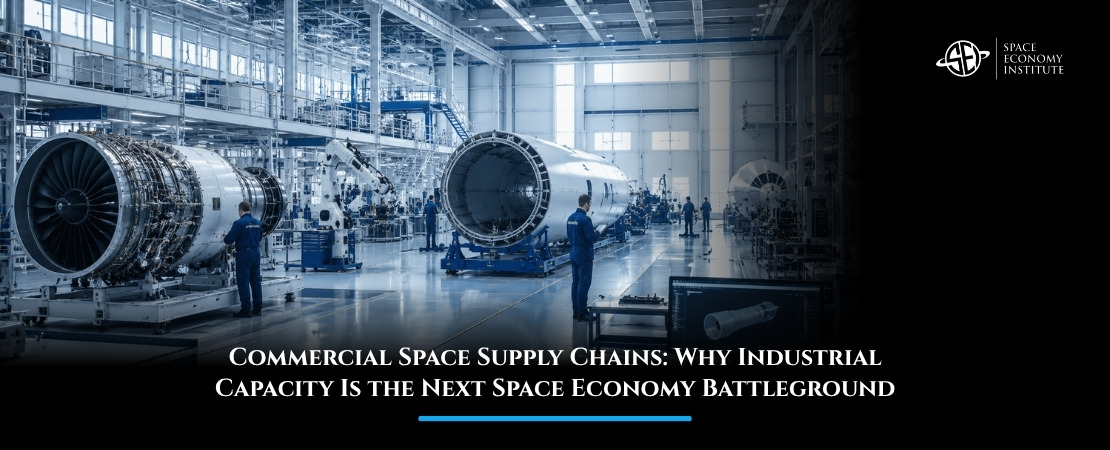
Space Growth Now Depends on the Factory Floor
The space economy is scaling fast, but the next bottleneck may not be launch pads or satellite demand. It may be the industrial base behind them. On August 18, 2026, the U.S. Office of Space Commerce and the Aerospace Industries Association are hosting the Commercial Space Supply Chain Forum in Arlington, Virginia. The event signals a major shift: space competitiveness now depends on suppliers, manufacturers, testing capacity, investment flows, and production resilience.
Why Supply Chains Matter in Space
Space companies often attract attention through dramatic milestones: rocket launches, satellite deployments, lunar missions, and defense contracts. But every mission depends on a much deeper network of companies producing propulsion systems, avionics, semiconductors, sensors, structures, batteries, solar arrays, antennas, ground systems, software, and testing services.
These suppliers are the hidden foundation of the space economy. If they cannot scale, the entire sector slows down.
This is especially important because demand is rising across multiple markets at the same time. Satellite broadband companies need high-volume spacecraft production. Defense agencies need resilient constellations, missile tracking, secure communications, and responsive launch. Earth observation firms need sensors and data systems. Lunar companies need landers, payloads, power systems, robotics, and surface infrastructure.
The result is a pressure point: the space economy is no longer only about invention. It is about industrial execution.
The Importance of Tier 2 and Tier 3 Suppliers
One of the most valuable aspects of the Commercial Space Supply Chain Forum is its focus on what happens deeper in the supply chain. Large prime contractors and launch providers are visible, but Tier 2 and Tier 3 suppliers often determine whether production schedules are realistic.
In supply chain terms, Tier 1 suppliers usually work directly with the prime contractor or main system integrator. Tier 2 suppliers provide components, subsystems, materials, or services to those Tier 1 companies. Tier 3 suppliers sit even deeper in the chain, often producing specialized parts that feed into Tier 2 suppliers.
These smaller and mid-sized companies may provide specialized components, materials, test equipment, precision manufacturing, coatings, electronics, or software that larger companies cannot easily replace. If one supplier faces shortages, financing constraints, compliance burdens, or workforce gaps, the consequences can ripple across satellite and launch programs.
This is why supply chain visibility matters. Space companies need to know where dependencies exist, where capacity is fragile, and where demand signals are unclear. Governments also need to understand which parts of the industrial base are strategically critical before a bottleneck becomes a national security problem.
Manufacturing Capacity, Testing and Capital
Three issues are especially important: domestic manufacturing capacity, testing infrastructure, and access to capital.
Manufacturing capacity determines whether companies can move from prototypes to production. Many space startups can build one impressive spacecraft. Far fewer can build dozens or hundreds with consistent quality, cost control, and schedule discipline.
Testing and qualification capacity are equally important. Space hardware must survive vibration, vacuum, radiation, thermal cycling, and launch stress. If test facilities are limited or oversubscribed, even well-funded companies can face delays.
Capital access is the third constraint. Expanding a factory, buying machines, hiring specialized workers, or qualifying a new component line requires upfront investment. Smaller suppliers may not receive enough long-term demand visibility to justify that investment. This creates a market failure: everyone needs more capacity, but suppliers may hesitate to build it without predictable orders.
Regulation and Competitiveness
Supply chain resilience is also linked to regulation. Export controls, licensing, cybersecurity requirements, compliance costs, and procurement rules can shape how quickly companies scale and how easily they work with government or international partners.
The challenge is balance. Space needs strong security and responsible oversight, especially for dual-use technologies. But if compliance becomes too slow or unclear, innovation and manufacturing investment can suffer.
This is why government-industry forums matter. They can identify where better coordination, clearer policy, or targeted investment may strengthen the whole ecosystem.
What Comes Next for the Space Industrial Base
The Commercial Space Supply Chain Forum affects launch companies, satellite manufacturers, component suppliers, investors, defense agencies, regulators, startups, and commercial operators. It shows that the next phase of space competition will be decided not only in orbit, but inside factories, test facilities, supply networks, and policy rooms.
If this topic is of interest, you can learn more about space manufacturing, commercial space strategy, supply chains, policy, and industrial competitiveness in the Master in Space Economy by the Space Economy Institute. Discover more about the Master and explore how the industrial base is shaping the future of the global space economy.