
Falcon 9 Moon Impact: Why Cislunar Traffic Management Is Now a Space Economy Priority
- August 6, 2026
- Posted by: admin
- Category: Uncategorized
A Rocket Stage Hits the Moon
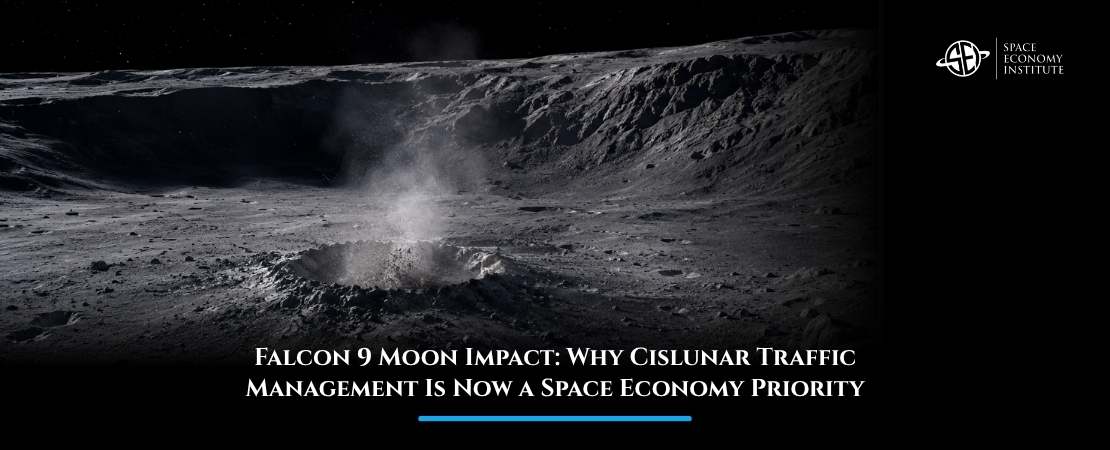
On August 5, 2026, a spent Falcon 9 upper stage struck the lunar surface near the Einstein Crater region, after months of tracking by astronomers, NASA and SpaceX. The event was not dangerous to Earth, and it did not threaten any crewed mission, but it has become a powerful reminder that the next phase of the space economy will require better management of objects moving through cislunar space. As missions to the Moon increase, the question is no longer only how to reach cislunar space. It is how to track, manage and responsibly dispose of the hardware we send there.
From a Commercial Lunar Launch to an Unplanned Impact
The rocket stage came from a January 15, 2025 Falcon 9 mission that launched Firefly Aerospace’s Blue Ghost 1 lunar lander under NASA’s Commercial Lunar Payload Services initiative. After completing its job, the upper stage remained in space. Over time, a combination of solar activity and gravitational forces altered its path, leading to an unplanned return to the Moon.
NASA stated that it remained in communication with SpaceX about the upper stage and its flight path. Independent astronomers first identified the trajectory using public data, and NASA’s Center for Near Earth Object Studies later confirmed that the object had a 100% chance of impacting the Moon.
This matters because it shows both the strengths and gaps of today’s cislunar monitoring system. The object was detected, tracked and predicted. But the event also reveals that more commercial missions will create more spent stages, transfer vehicles and mission hardware moving through Earth-Moon space.
From Space Debris to Lunar Traffic
Most discussions about space debris focus on low Earth orbit, where thousands of satellites, rocket bodies, and fragments share increasingly crowded orbital highways. But the Falcon 9 lunar impact points to a broader challenge: the space economy is expanding beyond Earth orbit.
Cislunar space, the region between Earth and the Moon, is becoming more active. Lunar landers, relay satellites, scientific probes, commercial payloads, upper stages, transfer vehicles, and future cargo systems will all move through this environment. As the Moon becomes a destination for exploration and commercial activity, tracking what happens after launch becomes just as important as launch itself.
The Falcon 9 stage was linked to a January 2025 lunar mission that sent private landers toward the Moon. After completing its role, the upper stage remained on a trajectory that eventually led to lunar impact. That outcome was predictable and scientifically useful, but it also raises an economic question: who is responsible for tracking, cataloguing, and managing spent hardware in cislunar space?
Why This Matters for the Lunar Economy
A single spent rocket stage hitting the Moon is not a crisis. The lunar surface is already struck by natural meteoroids every day. NASA estimated that the Falcon 9 upper stage could create a crater about 60 feet wide and 12 feet deep, while noting that a meteoroid with similar impact energy hits the Moon roughly every six days.
The economic concern is not this one crater. It is the future operating environment.
Future lunar infrastructure could include habitats, landing pads, communications towers, power stations, rovers, scientific instruments, mining experiments, and logistics depots. These assets will be expensive, fragile, and strategically important. As more missions operate near or on the Moon, unmanaged objects become a planning risk.
The issue is not only physical collision. It is uncertainty. Mission planners need to know where objects are, where they are going, whether they could interfere with operations, and whether they might contaminate scientifically valuable sites. Investors and insurers will also want clearer standards before financing lunar infrastructure.
In this sense, cislunar tracking is not an academic concern. It is a prerequisite for a bankable lunar economy.
The Science Opportunity
The impact also created scientific value. Researchers had predicted that the Falcon 9 upper stage would strike near Einstein Crater at roughly 2.4 kilometers per second, potentially producing a visible flash, ejecta plume, and new crater. Some models estimated that the debris plume could rise tens of kilometers above the lunar surface.
NASA said its Meteoroid Environments Office would attempt to observe the event using ground-based telescopes, although weather and lighting conditions could make real-time observation difficult.
The agency also said its Lunar Reconnaissance Orbiter and the ShadowCam instrument aboard South Korea’s Korea Pathfinder Lunar Orbiter would look for opportunities to image the impact site before and after the event. Those images could help scientists study ejecta plumes, crater formation and lunar surface behavior.
Even if direct observations were difficult, the event offers a test case for future impact monitoring. Scientists can use it to refine models of lunar regolith behavior, ejecta dynamics, crater formation, and observational planning. This matters because controlled or well-characterized impacts could support future lunar seismology, surface hazard analysis, and planetary science.
For the space economy, better science means better engineering. Understanding how impacts behave on the Moon can inform landing-zone planning, surface construction, dust mitigation, and protection strategies for future infrastructure.
Governance & Responsible Disposal in the Cislunar Economy
The Falcon 9 impact also exposes a governance gap. Low Earth orbit has debris mitigation guidelines, tracking systems, and growing regulatory attention. Cislunar space is less mature. There is no fully developed global traffic management system for the Earth-Moon environment.
That gap will become more serious as Artemis, commercial lunar landers, Chinese lunar missions, Indian lunar programs, private cargo services, and future resource projects increase activity. Without better coordination, the Moon could become a new domain of operational confusion.
The next step is clear: space agencies, companies, insurers, and regulators need shared standards for mission disposal, trajectory transparency, object tracking, data sharing, and lunar impact reporting.
Conclusion
The Falcon 9 lunar impact is more than an unusual space event. It is a preview of the operational challenges that come with a busier Earth-Moon economy. Tracking and managing cislunar objects will be essential for science, safety, investment and future lunar infrastructure.
If this topic is of interest, you can learn more about cislunar logistics, lunar infrastructure, space sustainability and commercial space governance in the Master in Space Economy by the Space Economy Institute. Discover more about the Master and explore how responsible operations beyond Earth orbit will shape the next phase of the space economy.