
SpaceX’s $1.6B Space Force Contract: National Security Launch Drives the Space Economy
- July 31, 2026
- Posted by: admin
- Category: Uncategorized
Defense Demand Moves to the Center of Launch
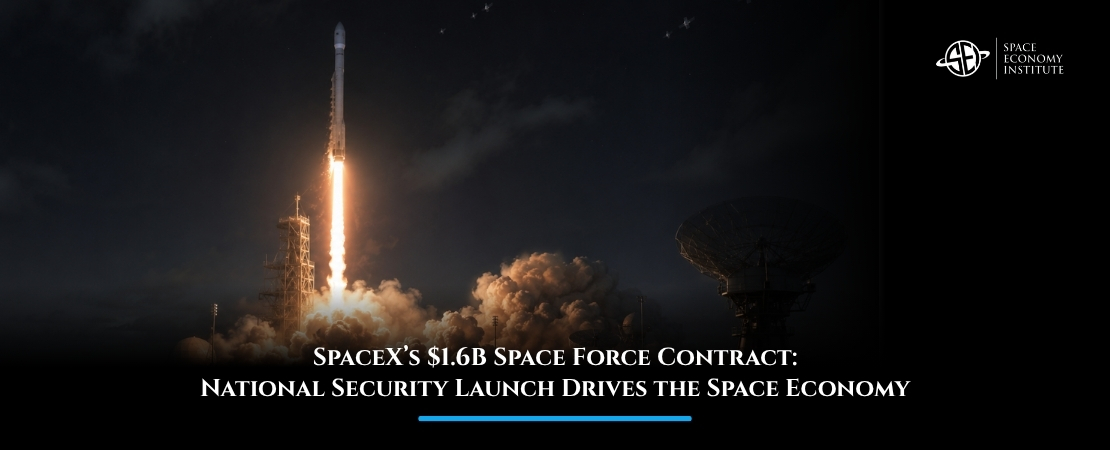
The commercial launch market is being reshaped by national security demand. On July 29, 2026, the U.S. Space Force awarded SpaceX a $1.6 billion order for 18 Falcon 9 launches through 2027. The missions will carry Pentagon satellites linked to space-based sensing and targeting, a portfolio designed to improve how the military detects, tracks, and responds to airborne and missile threats. For the space economy, the contract shows that launch is becoming strategic infrastructure.
What the Contract Covers
The award falls under the National Security Space Launch Phase 3 Lane 1 framework, a procurement model designed for commercial-style launch services from prequalified providers. Unlike the most sensitive national security missions, Lane 1 is intended to give the Space Force greater flexibility, faster acquisition, and access to a broader launch provider base.
SpaceX’s order includes 18 Falcon 9 missions, expected to support the Space Based Sensing and Targeting portfolio. These satellites are part of a wider shift toward distributed military space architectures: instead of relying only on a small number of large, expensive spacecraft, the Pentagon is increasingly deploying networks of smaller satellites in low Earth orbit.
This approach can improve resilience. If one satellite is lost, degraded, or targeted, the broader network can continue operating. It also supports faster data delivery to military users, especially for missile warning, tracking, communications, and targeting information.
Why Falcon 9 Remains Strategically Important
The award also confirms the continuing strategic relevance of Falcon 9, even as SpaceX develops Starship. Falcon 9 has become the backbone of U.S. launch cadence, supporting commercial satellites, Starlink, NASA missions, and national security payloads.
For government customers, reliability matters as much as innovation. Falcon 9’s high flight rate, reusability, established manufacturing base, and operational experience make it attractive for missions that need both speed and confidence. In a defense context, launch availability is not simply a commercial convenience; it affects how quickly new capabilities can be placed into orbit.
The implied value of the contract also shows how national security launch can differ from ordinary commercial pricing. Military missions often involve additional requirements around security, integration, schedule assurance, mission analysis, and range coordination. That creates higher-value launch work and deepens the relationship between commercial providers and defense customers.
The Rise of Proliferated Military Space Networks
The Space Force order is part of a larger transformation in defense space architecture. The U.S. is moving toward proliferated satellite networks for missile warning, missile tracking, tactical communications, and battlefield data transport.
The Space Development Agency’s proliferated warfighter space architecture is a key example. Recent Falcon 9 launches have carried transport-layer satellites designed to create an optically connected network in low Earth orbit, supporting near-real-time data movement for military users.
This is where the space economy and defense strategy increasingly overlap. Building these networks requires launch services, satellite manufacturing, ground systems, optical links, cybersecurity, cloud processing, propulsion, tracking software, and mission operations. A single launch contract therefore supports a much larger industrial ecosystem.
A Competitive Market, but Not an Equal One
The Space Force wants competition. The National Security Space Launch Phase 3 Lane 1 pool includes several providers, including SpaceX, United Launch Alliance, Blue Origin, Rocket Lab, Stoke Space, Firefly Aerospace, and Relativity Space. The goal is to expand capacity and avoid dependence on one supplier.
Yet SpaceX remains dominant because it already has operational scale. In launch markets, experience compounds. More flights improve processes, increase confidence, and help spread fixed costs across a larger mission base. Competitors are emerging, but they must prove cadence, reliability, pricing, and customer trust.
This creates a central tension in the launch economy: governments want competition, but the market currently rewards the provider with the most proven scale.
Conclusion
SpaceX’s $1.6 billion Space Force contract is more than another launch order. It shows that national security demand is becoming one of the strongest forces shaping the commercial space economy. Missile tracking, resilient satellite networks, and rapid access to orbit are turning launch capacity into a strategic asset.
If this topic is of interest, you can learn more about national security space, launch markets, satellite constellations, and commercial space strategy in the Master in Space Economy by the Space Economy Institute. Discover more about the Master and explore how defense demand is shaping the future of the global space economy.