
ESA 2026 Space Economy Report: Defence, Satellites and Europe’s Strategic Space Shift
- July 23, 2026
- Posted by: admin
- Category: Economics
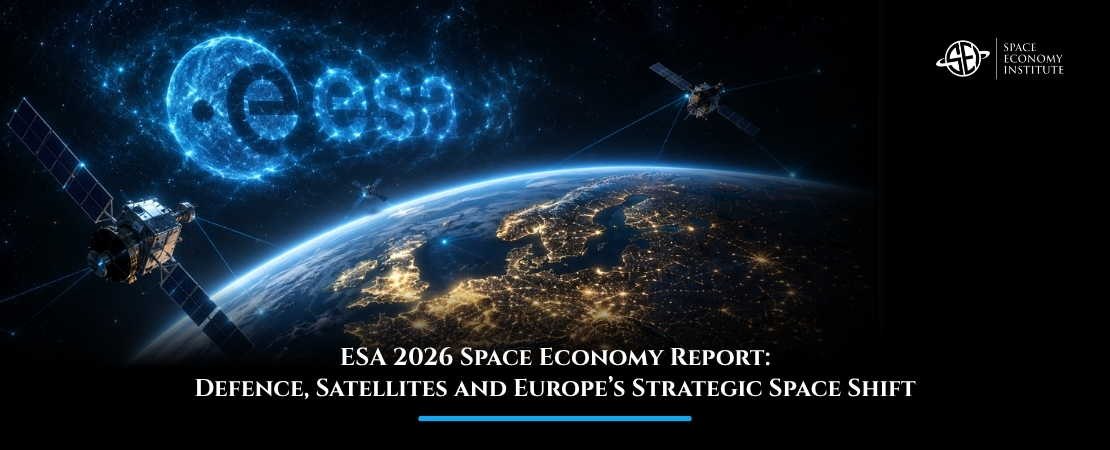
Europe’s Space Economy Enters a New Phase
The European Space Agency’s newly released 2026 Space Economy Report arrives at a crucial moment for the global space sector. As of July 23, 2026, governments, investors, and companies are reassessing the role of space in security, connectivity, industrial competitiveness, and digital infrastructure. The report shows that space is no longer a specialized aerospace niche. It is becoming a strategic layer of the modern economy.
Defence Is Reshaping Space Demand
One of the clearest messages from ESA’s 2026 report is that defence is now a central force in the space economy. Global public investment in space reached €119 billion in 2025, slightly down by 3% from 2024, but the composition of that spending is changing.
ESA notes that the decline was influenced by changes in U.S. defence budgets and flat NASA funding. Europe, however, moved in the opposite direction. European space budgets grew by 12% to €13.5 billion, marking the first double-digit growth rate in five years. Much of this increase was driven by national defence spending, especially from Germany.
This is important because space capabilities are now directly linked to national security. Satellite communications, Earth observation, missile warning, navigation, space domain awareness, and resilient launch access are becoming essential tools for governments. The result is a more strategic, security-focused space market.
For companies, this creates opportunity but also pressure. Space firms must increasingly understand defence procurement, cybersecurity, resilience, sovereignty, and dual-use technology.
Upstream Space: Manufacturing and Launch Under Institutional Demand
ESA values the upstream space market, which includes spacecraft manufacturing and launch services, at around €75 billion. The report also highlights that 80% of upstream demand is institutional, now dominated by defence.
That detail matters. While the commercial space narrative often focuses on startups, private capital, and consumer services, the upstream segment still depends heavily on government customers. Rockets, satellites, propulsion systems, secure payloads, and mission infrastructure often require public demand to scale.
Europe’s position is mixed but improving. ESA reports that European prime contractors regained market share, capturing 10% globally and 65% of their accessible market. This suggests that Europe is strengthening its industrial base, but still operates in a highly competitive environment dominated by the United States and China.
For Europe, the strategic challenge is clear: maintain technological autonomy while building companies that can compete globally.
Downstream Space: The Commercial Engine
If upstream space remains largely institutional, the downstream market tells a different story. ESA estimates the downstream space market at approximately €490 billion in 2025. This segment includes satellite communications, Earth observation, and Global Navigation Satellite System services.
GNSS-related services dominate the downstream market, accounting for 77% of activity. This reflects how deeply satellite signals are embedded in daily life. Navigation, timing, logistics, banking, mobility, agriculture, emergency response, and digital platforms all rely on space infrastructure, often invisibly.
This is where the space economy becomes part of the wider digital economy. The most valuable space businesses may not always look like traditional aerospace companies. They may be data analytics firms, telecom operators, insurance platforms, mobility companies, precision agriculture providers, or AI companies using satellite data and signals as core inputs.
Private Capital and Europe’s Investment Gap
The report also points to a sharp contrast in private investment. Globally, private investment in space rose by 60%, supported by a 177% increase in U.S. activity. European space ventures raised €1.4 billion, an 8% decrease from 2024, although still the second-highest annual total on record.
This is both encouraging and concerning. Europe has strong technology, skilled engineers, institutional support, and strategic demand. But if private capital does not scale at the same speed as the United States, European companies may struggle to grow fast enough in launch, satellite manufacturing, Earth observation, connectivity, and defence-related space services.
The next phase of Europe’s space economy will depend not only on public budgets, but on whether investors, banks, corporations, and institutions can provide enough growth capital to turn technical excellence into global market leadership.
Conclusion
ESA’s 2026 Space Economy Report shows that space is becoming more strategic, more commercial, and more embedded in everyday economic systems. Defence demand is reshaping public spending, downstream services are powering digital markets, and private capital is becoming a competitive advantage.
If this topic is of interest, you can learn more about space investment, satellite markets, European space policy, and commercial space strategy in the Master in Space Economy by the Space Economy Institute. Discover more about the Master and explore how space is becoming a core infrastructure layer of the global economy.