
Reflect Orbital Space Mirror: The Rise of Sunlight-as-a-Service
- July 14, 2026
- Posted by: admin
- Category: Innovation
A New Experiment in Orbital Energy
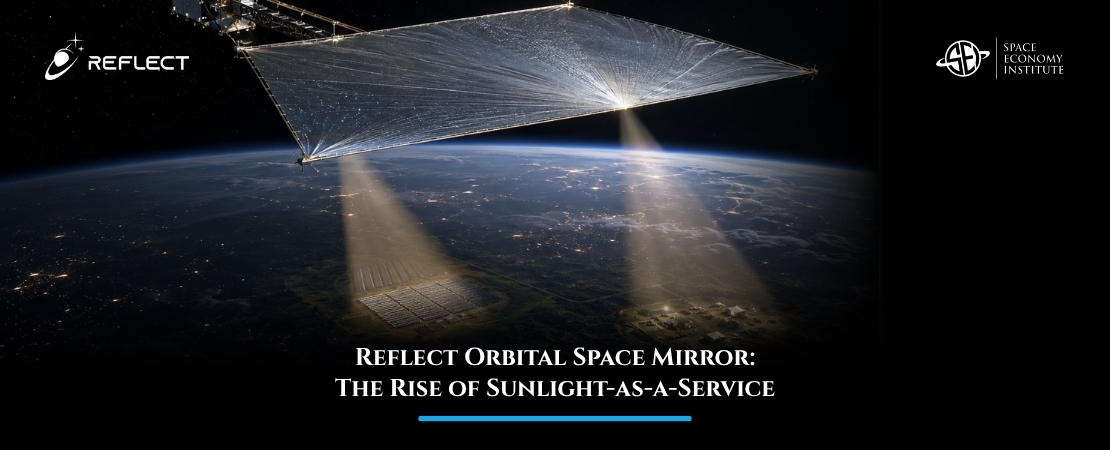
The space economy is moving beyond rockets, satellites, and communications into more experimental infrastructure services. On July 14, 2026, Reflect Orbital’s first sunlight-reflecting satellite received U.S. launch approval, bringing a controversial but fascinating idea closer to reality: using mirrors in orbit to redirect sunlight to Earth after dark. If successful, this could open a new market for space-based energy support, emergency response, agriculture, and nighttime industrial operations.
What Reflect Orbital Is Trying to Build
Reflect Orbital is developing a satellite called Eärendil-1, equipped with an ultra-thin reflective surface designed to redirect sunlight from space toward selected areas on Earth. The first satellite is a prototype, not a full commercial system. Its purpose is to test whether a large, lightweight orbital mirror can be deployed, pointed accurately, and operated safely in low Earth orbit.
The concept sounds futuristic, but the business idea is clear. Solar energy is limited by night, weather, and geography. If sunlight could be redirected to specific ground locations after sunset, it could extend solar power production, support emergency zones, illuminate remote industrial sites, assist agriculture, or help construction and logistics operations.
In marketing terms, Reflect Orbital is not simply selling a satellite. It is exploring the idea of sunlight-as-a-service: a space-enabled utility that customers could request when and where additional illumination is valuable.
Why This Matters for the Space Economy
The Reflect Orbital project highlights a broader shift in the space economy. Companies are no longer only using space to observe Earth or transmit data. They are trying to deliver physical services from orbit.
This is an important evolution. Communications satellites move information. Earth observation satellites create intelligence. Navigation satellites provide positioning. Space mirrors, if viable, would deliver energy-related utility directly to the ground.
That places Reflect Orbital in the same conceptual family as space-based solar power, orbital data centers, in-space manufacturing, and climate infrastructure. These markets are still early, but they share one theme: using the unique environment of space to provide services that are difficult or impossible on Earth.
For investors, the attraction is obvious. A satellite constellation that provides repeatable, on-demand services could generate recurring revenue. For governments, it could offer resilience during disasters, blackouts, military operations, or remote infrastructure emergencies. For solar operators, it could theoretically increase the productivity of ground-based assets.
The Controversy: Innovation Meets Orbital Responsibility
The project is also controversial, and for good reason. Astronomers, dark-sky advocates, environmental groups, and aviation observers have raised concerns about light pollution, interference with optical astronomy, effects on wildlife, and visibility from the ground.
This is where the space economy faces a serious governance challenge. The commercial value of orbital infrastructure must be balanced against shared access to the night sky, scientific research, environmental protection, and public trust.
Reflect Orbital’s current approval covers only a demonstration satellite, not a full constellation. But the company’s long-term vision reportedly involves thousands of satellites. That scale would raise much larger questions around orbital congestion, brightness, regulation, collision risk, environmental assessment, and international coordination.
In other words, the prototype may be small, but the debate is large.
A Test Case for the Next Generation of Space Markets
Eärendil-1 could become a test case for how regulators evaluate novel space services. Traditional satellite regulation was built around communications, spectrum use, remote sensing, and launch safety. New space business models increasingly blur those categories.
A space mirror is not just a communications asset. It affects the visual environment, energy systems, aviation considerations, and potentially ecological patterns. That means future space regulation may need to become more interdisciplinary, combining aerospace safety, environmental science, astronomy, energy policy, and commercial licensing.
The companies that succeed in this next generation of space markets will not be those that innovate fastest at any cost. They will be those that innovate while earning public legitimacy.
Conclusion
Reflect Orbital’s approved space mirror satellite is one of the most unusual and strategic experiments in the 2026 space economy. It shows how space infrastructure could move from data services toward direct physical utility, while also exposing the need for responsible governance.
If this topic is of interest, you can learn more about orbital infrastructure, space-based energy, satellite regulation, and emerging space markets in the Master in Space Economy by the Space Economy Institute. Discover more about the Master and explore how new space technologies are expanding what the space economy can become.