
China’s Long March 10B Recovery: A New Reusable Rocket Milestone for the Space Economy
- July 10, 2026
- Posted by: admin
- Category: Innovation
A New Step in the Reusability Race
Reusable rockets are one of the most important technologies in the modern space economy. They reduce launch costs, increase flight cadence, and make large satellite constellations more practical. On July 10, 2026, China successfully tested a sea-based recovery system for the Long March 10B booster, marking a major step in its effort to build reusable launch capacity and compete in the global commercial launch market.
Why Reusability Changes the Economics of Space
For most of space history, rockets were used once and discarded. That model made launch expensive, slow, and dependent on complex manufacturing cycles. Reusability changes the business case. If a booster can be recovered, inspected, refurbished, and flown again, the cost of access to orbit can fall over time.
This matters because the space economy is becoming launch-intensive. Satellite megaconstellations, Earth observation fleets, defense networks, lunar missions, orbital servicing, and space-based data infrastructure all require frequent and reliable launches. The countries and companies that master reusability can deploy infrastructure faster and at lower cost.
SpaceX proved the commercial power of this model with Falcon 9. Its reusable first stage helped create a launch system capable of supporting Starlink, commercial satellites, NASA missions, national security payloads, and international customers. China’s Long March 10B recovery shows that the reusability race is no longer only an American story.
China’s Sea-Based Recovery System
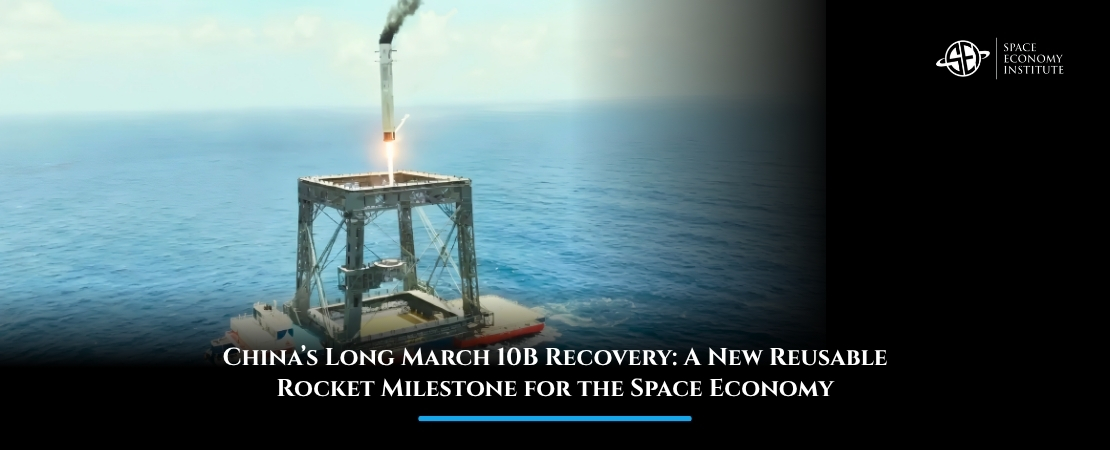
The Long March 10B test is especially interesting because China used a different recovery approach from SpaceX. Instead of landing the booster on legs, the rocket descended toward an offshore recovery platform and used four landing hooks to catch a net system.
According to Chinese launch developers, this design can reduce the structural mass required for landing legs while improving payload capacity and recovery flexibility. If the system proves reliable, it could become an efficient alternative for reusable medium-lift rockets.
The Long March 10B is being developed by the China Academy of Launch Vehicle Technology for commercial aerospace use. It is designed to carry at least 16 metric tons to low Earth orbit, making it relevant for satellite constellation deployment, commercial payloads, and future institutional missions.
The booster separated from the upper stage and returned to Earth within minutes, demonstrating the guidance, control, descent, and capture technologies needed for future reuse. Chinese reports indicate that the recovered booster is expected to fly again before the end of the year, which would be a critical proof point for true operational reusability.
Strategic Competition Beyond Launch Price
The economic impact of reusable rockets goes beyond cheaper launches. Reusability supports national strategy.
China is building large satellite constellations, expanding its commercial launch sector, and preparing for crewed lunar missions before 2030. To support those ambitions, it needs reliable, high-cadence launch systems. A reusable Long March 10B could help deploy broadband satellites, Earth observation systems, and strategic space infrastructure more efficiently.
It also strengthens China’s private and state-linked space ecosystem. In recent years, Chinese policy has encouraged commercial rocket companies and capital-market access for firms working on reusable launch technology. That means reusability is not only a technical objective. It is an industrial policy tool.
For global customers, more reusable launch providers could mean more competition, more launch availability, and potentially lower prices. For governments, it raises the stakes of sovereign access to space. Launch is becoming not just a service, but a strategic capability.
The New Launch Economy
The Long March 10B recovery highlights a broader transformation in the launch market. The next decade will not be defined only by who can reach orbit. It will be defined by who can reach orbit repeatedly, affordably, safely, and at scale.
Reusable systems also create opportunities across the value chain: recovery vessels, offshore platforms, refurbishment facilities, propulsion systems, avionics, thermal protection, inspection technologies, insurance, and launch operations software.
But success is not guaranteed. Recovery is only the first step. The real test is whether boosters can be reused quickly, safely, and economically across multiple flights. That is where the business case becomes real.
Conclusion
China’s Long March 10B recovery is a major signal for the global space economy. It shows that reusable launch competition is expanding, and that access to orbit is becoming a field of industrial, commercial, and geopolitical rivalry.
If this topic is of interest, you can learn more about reusable rockets, launch economics, satellite constellations, and strategic space infrastructure in the Master in Space Economy by the Space Economy Institute. Discover more about the Master and explore how reusable launch systems are changing the future of access to space.