
Space Debris Removal: The New Space Economy Market Cleaning Up Earth Orbit
- July 9, 2026
- Posted by: admin
- Category: Uncategorized
The Business Case for a Cleaner Orbit
Earth orbit is becoming one of the most valuable infrastructure zones in the global economy. Satellites now support communications, navigation, weather forecasting, Earth observation, defense, banking, agriculture, and emergency response. But the same growth that powers the space economy is creating a dangerous problem: orbital debris. As of July 2026, space junk is no longer only an environmental issue. It is becoming a commercial, regulatory, and strategic market.
From Space Junk to Infrastructure Risk
Space debris includes defunct satellites, spent rocket stages, mission fragments, and collision debris. Even small objects can be dangerous because they travel at extremely high orbital speeds. A piece of debris just a few centimeters wide can damage or destroy an operational satellite.
The risk is growing because low Earth orbit is becoming more crowded. ESA’s latest debris statistics estimate more than 1.2 million objects between 1 cm and 10 cm and 140 million objects between 1 mm and 1 cm, showing why debris is now a serious operational risk for satellite operators. Megaconstellations, Earth observation fleets, national security satellites, and rideshare missions are increasing the number of objects in orbit. This creates more collision-avoidance maneuvers, more operational complexity, and higher insurance and mission-planning costs.
For satellite operators, orbital debris is not abstract. It affects satellite lifetime, fuel budgets, service reliability, customer contracts, and capital efficiency. A satellite forced to maneuver repeatedly may consume propellant faster. A collision can destroy an asset entirely. A congested orbital shell can make future deployment more expensive or technically difficult.
In other words, orbital sustainability is becoming a business requirement.
Regulation Is Creating Market Demand
One of the strongest drivers behind the debris-removal market is regulation. The U.S. Federal Communications Commission has adopted a five-year deorbit rule for satellites in low Earth orbit, requiring operators to dispose of spacecraft within five years after mission completion.
This is a major change from older norms, where satellites could remain in orbit for decades after their useful life. Shorter disposal timelines raise the standard for responsible operations. They also create demand for technologies that help satellites deorbit, maneuver, refuel, or be captured if they fail.
This is how regulation can turn a risk into a market. Satellite operators need compliance tools. Governments need safer orbital environments. Insurers need better risk models. Space agencies need protection for scientific and human spaceflight missions. Commercial companies now have an opportunity to provide active debris removal, inspection, tracking, collision avoidance, and end-of-life servicing.
The Rise of Active Debris Removal
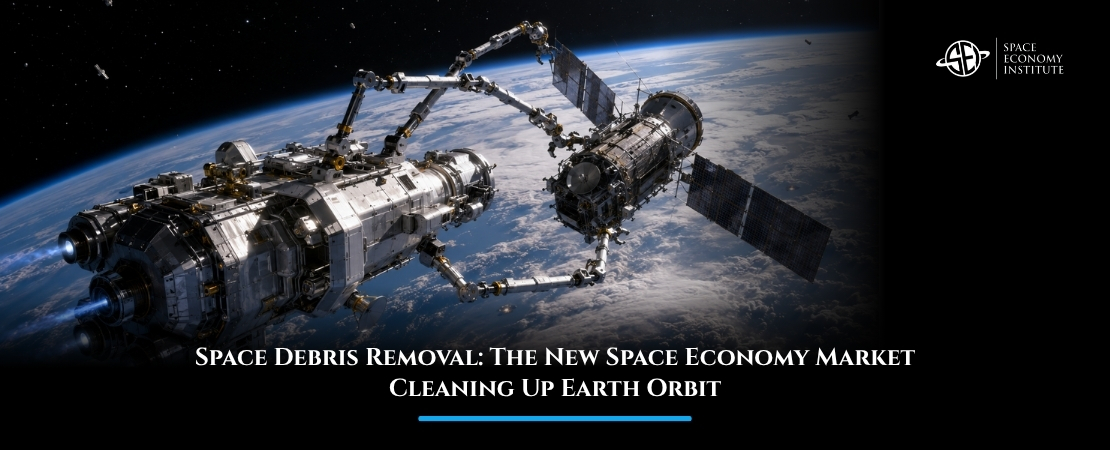
Active debris removal is the most visible part of the new market. Companies are developing spacecraft that can rendezvous with dead satellites or debris objects, inspect them, capture them, and either move them to a safer orbit or push them toward atmospheric reentry.
Different technical approaches are emerging. Some concepts use robotic arms. Others use nets, docking mechanisms, propulsion kits, or servicing vehicles. The key challenge is that debris objects are often uncontrolled, tumbling, and not designed to be captured.
That makes active debris removal technically difficult, but also commercially valuable. The same technologies used to remove debris can support satellite life extension, refueling, relocation, inspection, in-space logistics, and eventually construction in orbit.
This means the debris market may become part of a much larger orbital services economy.
Why Investors and Governments Are Watching
The economics of debris removal are still evolving. Many legacy debris objects do not have an obvious paying customer, which means government contracts may be needed to remove the highest-risk objects. But for new satellites, the market is clearer: operators may pay for compliance, risk reduction, mission extension, or insurance benefits.
This creates a layered business model. Space situational awareness companies track objects. Software providers support collision-avoidance decisions. Servicing companies offer rescue, relocation, or disposal. Launch companies provide deployment. Insurers price the risk. Regulators set the rules.
The result is a new value chain around orbital safety.
Conclusion
Space debris removal is becoming one of the most important enabling markets in the space economy. Without cleaner and better-managed orbits, satellite broadband, Earth observation, defense constellations, space stations, and future orbital data centers all face rising risk.
If this topic is of interest, you can learn more about orbital sustainability, space traffic management, satellite servicing, and emerging space markets in the Master in Space Economy by the Space Economy Institute. Discover more about the Master and explore how responsible orbital infrastructure will shape the future of space.