
Isar Aerospace in Canada: The New Spaceport Race for Sovereign Access to Orbit
- July 7, 2026
- Posted by: admin
- Category: Competitive research
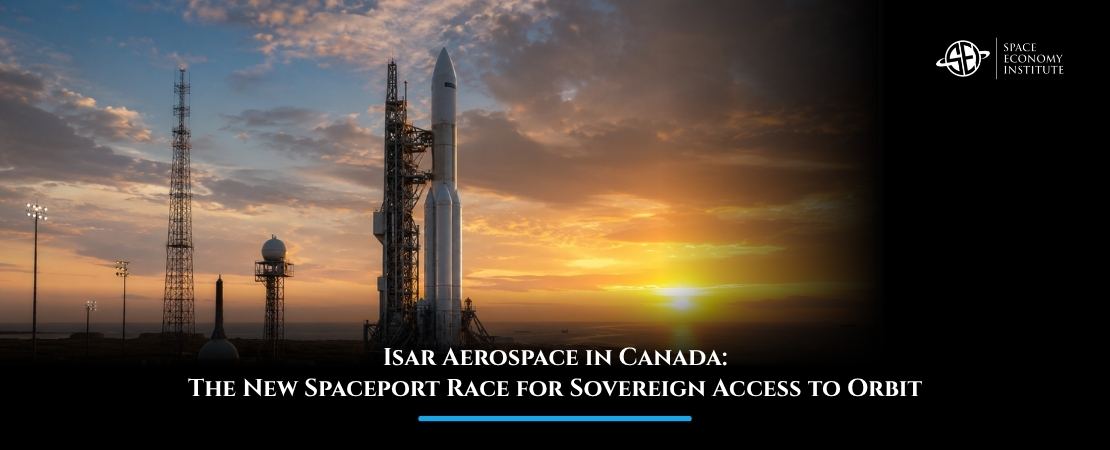
A New Launch Corridor Opens Across the Atlantic
The global launch market is entering a new phase. On July 7, 2026, German rocket company Isar Aerospace announced an agreement with Maritime Launch Services to build and use a dedicated launch pad at Spaceport Nova Scotia in Canada. This is more than a company expansion. It shows how launch sites are becoming strategic infrastructure for countries, investors, satellite operators, and allied space economies.
From Rockets to Launch Infrastructure
In the early commercial space era, the main focus was rocket technology: who could build cheaper, reusable, or more reliable launch vehicles. That still matters. But today, the bottleneck is not only the rocket. It is also the launch infrastructure.
Satellite operators need access to orbit with predictable schedules, regulatory clarity, and multiple geographic options. Defense customers need resilience. Governments want sovereign or allied launch capacity. Startups need launch slots that are not entirely dependent on a handful of dominant providers.
This is why spaceports are becoming economic assets. A launch site is not just a pad and a control room. It is a cluster of regulation, safety systems, ground operations, logistics, environmental approvals, tracking infrastructure, skilled labor, and international partnerships.
For the space economy, this means launch infrastructure is becoming a market in its own right.
Why Isar Aerospace Chose Canada
Isar Aerospace is one of Europe’s most closely watched private launch companies. Its Spectrum rocket is designed to serve the small and medium satellite market, especially missions to low Earth orbit. By developing a dedicated launch complex in Nova Scotia, Isar gains an additional operational base outside Europe and strengthens its ability to serve customers requiring different orbital inclinations, schedules, and geopolitical assurances.
Canada is also an attractive location. Spaceport Nova Scotia, near Canso on the Atlantic coast, is positioned for a range of commercial and defense launch trajectories. For European and North American customers, it offers a politically stable, allied environment with access to Atlantic launch corridors.
The agreement also supports Canada’s ambition to become a launch nation. Canada has world-class space expertise, especially in robotics, satellite systems, Earth observation, and exploration partnerships. But it has historically lacked domestic orbital launch capability. Spaceport Nova Scotia could help close that gap.
Sovereign Access Is Becoming a Business Case
The phrase “sovereign access to space” used to belong mostly to governments. Today, it is also a commercial argument.
The war in Ukraine, rising geopolitical competition, satellite internet dependency, defense-space integration, and supply-chain disruption have changed how countries view space infrastructure. Launch capacity is now linked to national resilience, security partnerships, emergency communications, and industrial competitiveness.
Canada’s recent push to create a national framework for commercial launch reflects this shift. The country wants to reduce dependence on foreign launch infrastructure while attracting investment, skilled jobs, and international space partnerships.
For Isar Aerospace, the same logic applies from the company side. A multi-site launch strategy can reduce operational risk. If one launch range is delayed by weather, regulation, range availability, or technical constraints, another site may offer flexibility. In a market where satellite operators value schedule certainty, that flexibility can become a competitive advantage.
The Rise of the Commercial Spaceport Economy
The Isar–Maritime Launch Services agreement also points to a broader trend: spaceports are multiplying.
Europe is developing launch capability from Norway, Sweden, the United Kingdom, and other locations. The United States continues to expand commercial launch ranges. Australia, New Zealand, Japan, India, and Canada are all positioning themselves in different parts of the launch value chain.
This does not mean every spaceport will succeed. Launch sites require high utilization, strong safety records, environmental legitimacy, and reliable customers. But the direction is clear: as the satellite market grows, launch infrastructure will become more distributed, more competitive, and more strategic.
For investors, this creates opportunities in ground systems, range safety, fuels, logistics, testing, insurance, data services, and launch operations. For governments, it creates leverage in industrial policy and security partnerships.
Conclusion
Isar Aerospace’s Spaceport Nova Scotia agreement shows that the launch economy is no longer only about rockets. It is about infrastructure, sovereignty, resilience, and market access. The next decade of commercial space will be shaped not just by who can build launch vehicles, but by who can provide reliable corridors to orbit.
If this topic is of interest, you can learn more about launch markets, spaceports, sovereign space infrastructure, and commercial space strategy in the Master in Space Economy by the Space Economy Institute. Discover more about the Master and explore how access to orbit is becoming one of the most important pillars of the space economy.