
Google Project Suncatcher: AI Data Centers in Space and the Next Digital Infrastructure Frontier
- July 3, 2026
- Posted by: admin
- Category: Innovation
A Moonshot for the AI Infrastructure Age
Artificial intelligence is creating one of the largest infrastructure challenges of the digital era. Training and running advanced AI systems requires enormous computing power, electricity, cooling capacity, and land. Google’s Project Suncatcher asks a bold question: could part of that future computing infrastructure move into orbit? As of July 2026, the idea is no longer just science fiction. It is becoming a serious space economy experiment.
What Is Google Project Suncatcher?
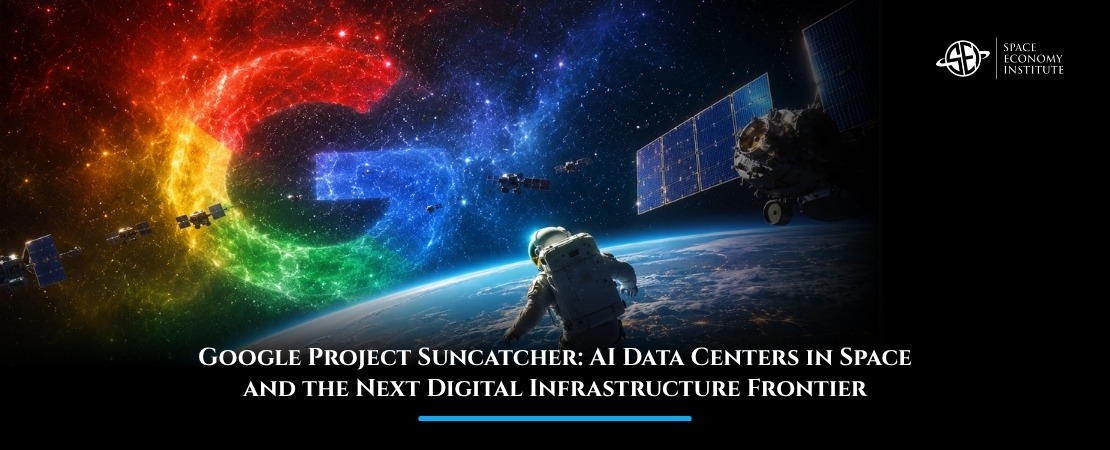
Project Suncatcher is Google’s research moonshot to explore space-based AI computing. The concept is to place solar-powered satellite constellations in orbit, equipped with Google’s Tensor Processing Units, or TPUs, and connected through high-speed optical links.
In simple terms, Google is exploring whether future AI data centers could be distributed across satellites rather than built entirely on Earth. These orbital systems would use abundant solar energy, process data in space, and communicate through laser-based networks.
The first step is not a full-scale space data center. It is a prototype. Google is reportedly working toward an initial launch around 2027 with Planet Labs, using small satellites to test whether AI chips and optical communication systems can perform reliably in the harsh environment of low Earth orbit.
The History of Project Suncatcher
Project Suncatcher did not emerge in isolation. It is part of a longer evolution in Google’s strategy around cloud computing, artificial intelligence, and advanced infrastructure. For years, Google has invested in custom AI hardware through its Tensor Processing Units, designed to accelerate machine learning workloads more efficiently than general-purpose chips.
At the same time, the company has faced the same structural pressure affecting the entire AI sector: data centers are becoming larger, more energy-intensive, and more difficult to scale on Earth. As AI demand grows, electricity availability, cooling, land use, permitting, and grid capacity are becoming strategic constraints.
Project Suncatcher represents Google’s attempt to think beyond terrestrial data center expansion. The idea is to combine three domains where Google already has deep capabilities: AI hardware, cloud architecture, and large-scale systems engineering. By moving part of the compute layer into orbit, Google is investigating whether solar-powered satellites could become a future extension of AI infrastructure.
This makes Project Suncatcher less of a traditional space mission and more of a digital infrastructure experiment. It sits at the intersection of cloud computing, satellite networks, optical communications, and the emerging market for orbital data centers.
Project Suncatcher Timeline
The timeline for Project Suncatcher is still early, but several milestones help frame its development.
The first phase is research and system design. This includes modeling whether solar-powered satellites can host AI chips, communicate through free-space optical links, manage heat, survive radiation, and operate as a distributed computing network.
The second phase is prototype testing. Google is reportedly planning an initial demonstration around 2027 with Planet Labs. This test is expected to involve small satellites in low Earth orbit and will likely focus on validating chip performance, thermal behavior, radiation exposure, laser communications, and satellite-to-satellite networking.
The third phase, if the prototype succeeds, would be scaling. This could involve larger constellations, more powerful AI hardware, stronger optical links, and deeper integration with Google Cloud infrastructure on Earth.
A full orbital AI data center network is not imminent. But the timeline shows that Google is moving from concept toward experimentation, which is exactly how new space economy markets begin.
Why AI Companies Are Looking to Orbit
The AI boom is putting pressure on terrestrial infrastructure. Large data centers require huge amounts of power, cooling systems, grid connections, water resources, and permitting. In some regions, data center expansion is already constrained by energy availability and environmental concerns.
Space offers a different possibility. Satellites in the right orbit can access near-continuous solar power. They can also process space-generated data closer to where it is produced, especially for Earth observation, defense monitoring, climate intelligence, and satellite network management.
This does not mean orbital data centers will replace terrestrial cloud infrastructure soon. The early opportunity is more specific: process data in orbit when sending raw information back to Earth is slow, expensive, or inefficient.
For example, an Earth observation satellite may capture massive volumes of imagery, but only a small fraction may contain useful information. If AI systems process that imagery in orbit, they could send back insights instead of raw data. This could reduce bandwidth demand, lower latency, and support faster decisions during disasters, military operations, wildfire detection, or maritime surveillance.
The Technical Barriers Are Serious
Project Suncatcher is ambitious because space is an unforgiving environment for computing. Radiation can damage electronics. Temperature swings can stress hardware. Maintenance is difficult. Launch costs still matter. Cooling is one of the hardest problems.
On Earth, data centers remove heat through air conditioning, water cooling, and surrounding infrastructure. In space, there is no air to carry heat away. Heat must be radiated, which requires careful spacecraft design, large surfaces, and efficient thermal management.
Networking is another major challenge. AI workloads often require rapid data exchange between chips and servers. In orbit, that means satellites must communicate through extremely reliable optical links while moving at high speed. The system must also connect with ground stations and existing cloud infrastructure.
A New Market for the Space Economy
If Project Suncatcher succeeds, it could create demand across several space economy sectors: satellite manufacturing, launch services, radiation-hardened AI chips, optical communications, thermal systems, space cybersecurity, orbital servicing, and space traffic management.
It could also change how we think about digital infrastructure. Space would no longer be only a place for observation, navigation, and communications. It could become part of the global compute layer, supporting AI workloads, autonomous satellite operations, and space-native data services.
Conclusion
Google Project Suncatcher is still a moonshot, but it points toward a powerful possibility: a future where AI infrastructure extends beyond Earth. The companies that solve orbital computing may help define the next generation of cloud, satellite, and space services.
If this topic is of interest, you can learn more about orbital data centers, AI infrastructure, satellite networks, and emerging space markets in the Master in Space Economy by the Space Economy Institute. Discover more about the Master and explore how digital infrastructure is moving into orbit.