
Swift Boost Mission and the On-Orbit Servicing Market: How NASA and Katalyst Are Reshaping Space Logistics
- June 24, 2026
- Posted by: admin
- Category: Economics
A Rescue Mission with Market Consequences
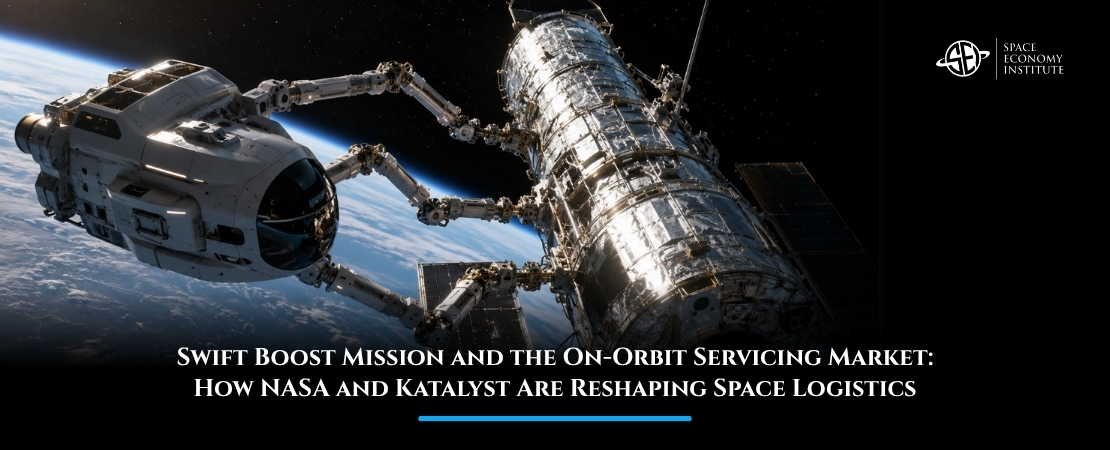
A NASA space telescope is falling toward Earth, and a private spacecraft may soon help save it. The upcoming Swift Boost mission, led by Katalyst Space Technologies, is more than a dramatic orbital rescue attempt. It is a live demonstration of one of the most strategic markets in the space economy: on-orbit satellite servicing, where spacecraft are repaired, repositioned, upgraded, or extended after launch.
From Disposable Satellites to Serviceable Infrastructure
For most of space history, satellites have been treated like disposable machines. Once launched, they either worked until fuel, hardware, or orbital conditions ended their lives, or they became stranded, deorbited, or abandoned. That model made sense when satellites were few, expensive, and difficult to reach.
But the space economy has changed. Earth orbit is now crowded with communications satellites, Earth observation platforms, defense assets, scientific observatories, and megaconstellations. Many of these spacecraft are worth hundreds of millions of dollars. Losing them early can mean lost data, lost revenue, and lost strategic capability.
On-orbit servicing changes the economics. Instead of replacing a satellite, operators may be able to extend its life, move it to a safer orbit, inspect damage, repair components, or remove it responsibly. This turns space from a “launch and leave” environment into an operational infrastructure domain.
Swift Boost: A Timely Test Case
NASA’s Neil Gehrels Swift Observatory was launched in 2004 to study gamma-ray bursts and other high-energy cosmic events. After more than two decades in orbit, Swift remains scientifically valuable, but its altitude has been declining because of atmospheric drag. Recent solar activity has expanded Earth’s upper atmosphere, accelerating the observatory’s orbital decay.
NASA says Katalyst’s LINK robotic servicing spacecraft will launch in June aboard a Northrop Grumman Pegasus XL rocket and attempt to capture and raise the Neil Gehrels Swift Observatory over several months. NASA also states that Swift launched in 2004 and that recent solar activity accelerated its orbital decay. Reuters previously reported that NASA awarded Katalyst a $30 million contract for the mission, while recent reporting says LINK is expected to launch on June 27 and could extend Swift’s life by at least five years. Market estimates also support the investment relevance: Fortune Business Insights projects the on-orbit services market to grow from $3.18 billion in 2026 to $6.87 billion by 2034.
The mission is technically important because Swift was not designed to be serviced. It does not have a docking port, refueling interface, or propulsion system capable of raising its own orbit. If LINK can rendezvous with Swift, capture it, and safely boost it to a higher altitude, the mission could prove that private companies can service valuable spacecraft even when they were not originally built for repair.
Why This Matters for the Space Economy
The business case for on-orbit servicing is becoming stronger. As satellites become more numerous and more valuable, operators need ways to protect assets already in space. This is especially important for government, defense, telecommunications, Earth observation, and scientific missions.
The market opportunity is broader than rescue missions. On-orbit servicing includes inspection, refueling, relocation, life extension, debris removal, in-space assembly, and future orbital warehousing. These services could support commercial space stations, lunar logistics, sovereign satellite networks, and resilient defense architectures.
For investors, this sector is attractive because it sits at the intersection of space sustainability and recurring services. A company that can repeatedly service satellites may develop a business model closer to infrastructure maintenance than one-off hardware sales.
The Rise of Space Logistics
Swift Boost also points toward a deeper transformation: space logistics. As activity grows in low Earth orbit, geostationary orbit, and eventually cislunar space, operators will need orbital transfer vehicles, fuel depots, servicing hubs, autonomous docking systems, and robotic repair platforms.
This is similar to the evolution of aviation or maritime transport. Mature transportation systems require maintenance, refueling, traffic management, rescue capabilities, and supply chains. Space is moving in the same direction.
Conclusion
The Swift Boost mission shows that on-orbit satellite servicing is moving from concept to market reality. If successful, it could preserve a valuable NASA observatory, reduce orbital waste, and demonstrate a new commercial service category in space logistics.
If this topic is of interest, you can learn more about on-orbit servicing, satellite life extension, and space logistics in the Master in Space Economy by the Space Economy Institute. Discover more about the Master and explore how orbital infrastructure is reshaping the future of the space economy.