
EQT Acquires Exolaunch: Why Private Equity Is Betting on the Space Economy
- June 18, 2026
- Posted by: admin
- Category: Funding trends
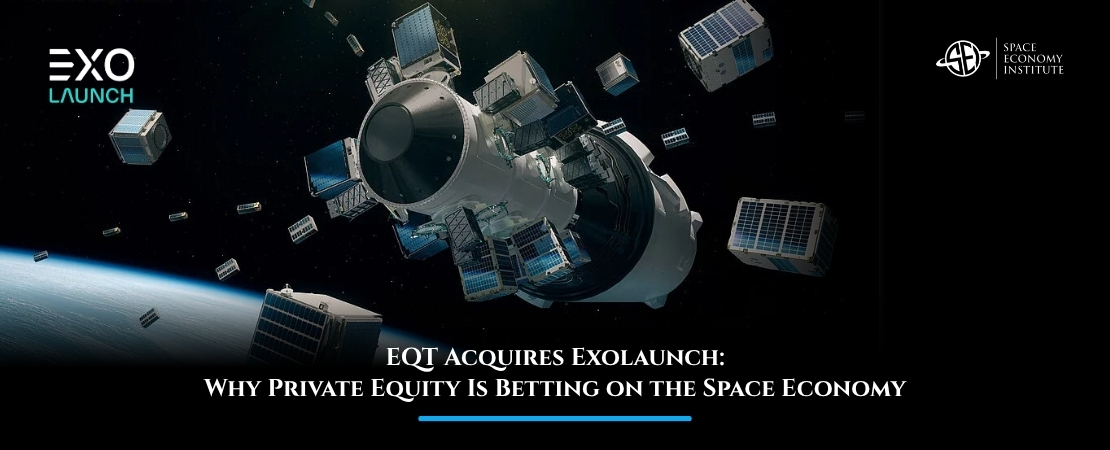
The space economy is entering a new investment phase. On June 18, 2026, Swedish private equity firm EQT announced the acquisition of Exolaunch, a Berlin-based satellite deployment and launch mission management company. The deal matters because it shows that institutional investors are no longer looking only at rockets or satellite operators. They are now targeting the hidden infrastructure that makes access to orbit scalable.
Why Exolaunch Matters in the Space Economy
Exolaunch is not a rocket company. That is exactly why the deal is important.
The company operates in the layer between satellite manufacturers and launch providers. It helps customers integrate spacecraft, manage missions, and deploy satellites safely into orbit. This is a critical service in a market where more companies, governments, universities, and defense organizations want to launch small satellites but do not have the internal expertise to navigate the full mission process.
Exolaunch has deployed more than 790 satellites across 47 missions for over 200 customers globally. It has also participated in every SpaceX Falcon 9 Transporter and Bandwagon rideshare mission since those programs began. In practical terms, Exolaunch has become a trusted access-to-space partner for the small satellite economy.
This is the kind of company that rarely receives mainstream attention but plays an essential role in the value chain. As the number of satellites grows, launch is no longer just about lifting mass into orbit. It is about coordination, reliability, deployment precision, regulatory readiness, and mission assurance.
Why Private Equity Is Entering Space
The EQT acquisition signals that space is becoming attractive to a broader class of financial investors. Venture capital has traditionally dominated New Space funding, especially in early-stage launch, satellite, and Earth observation companies. Private equity, by contrast, usually prefers businesses with proven revenues, defensible market positions, and scalable operations.
Exolaunch fits that profile. It operates in a growing market, has flight heritage, serves commercial and government clients, and benefits from the expansion of satellite constellations. Instead of betting on a speculative rocket startup, EQT is investing in a mission-critical service provider that sits inside an already expanding ecosystem.
This reflects a wider trend: the space economy is maturing. As launch costs fall and satellite demand rises, the market needs industrial-scale support systems. Mission management, deployment hardware, ground infrastructure, in-orbit logistics, and space traffic coordination are becoming investable categories.
The Rise of Satellite Launch Services
Small satellites are transforming the economics of space. They are cheaper to build, faster to manufacture, and easier to deploy in batches. They support applications such as broadband connectivity, Earth observation, climate monitoring, defense intelligence, maritime tracking, and Internet of Things networks.
But launching small satellites is not simple. Customers need to select the right orbit, secure launch capacity, comply with regulations, integrate safely with the rocket, and deploy without damaging other payloads. That creates demand for specialized launch service providers.
This is where companies like Exolaunch become strategically valuable. Their role is similar to logistics companies in global trade: they make complex transport systems usable for many customers. As the space economy grows, satellite launch services could become one of its most important enabling markets.
Europe’s Space Investment Moment
The deal is also significant for Europe. Exolaunch was founded in Germany and has become a global player through partnerships with leading launch providers, including SpaceX. Its acquisition by EQT highlights the strength of European space technology beyond large agencies and prime contractors.
Europe has long debated how to strengthen its position in commercial space. While the United States leads in reusable launch and mega-constellations, Europe has strong capabilities in satellite manufacturing, mission services, robotics, and downstream applications. Investment in companies like Exolaunch shows that European space firms can attract global capital when they solve real bottlenecks.
Conclusion
EQT’s acquisition of Exolaunch is more than a financial transaction. It is a signal that the space economy is becoming investable at the infrastructure level. The next phase of growth will not be driven only by rockets or astronauts, but by the companies that make orbital access reliable, repeatable, and commercially scalable.
If this topic is of interest, you can learn more about satellite launch services, space investment trends, and commercial space infrastructure in the Master in Space Economy by the Space Economy Institute. Discover more about the Master and explore how the space economy is creating new markets, new careers, and new strategic opportunities.