
Amazon Leo and the New LEO Broadband Race
- June 17, 2026
- Posted by: admin
- Category: Economics
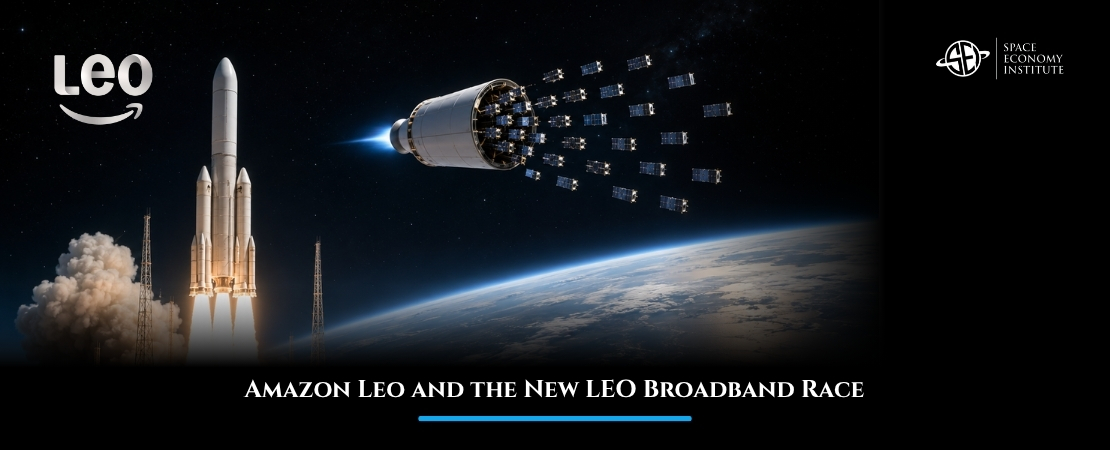
Satellite internet is becoming one of the most competitive and commercially important sectors of the space economy. On June 17, 2026, Amazon Leo is targeting a major Ariane 6 launch carrying 36 satellites, accelerating its effort to challenge Starlink’s dominance in low Earth orbit broadband. This is not just a telecom story. It is a turning point in the commercialization of orbital infrastructure.
Why LEO Broadband Matters Now
For decades, satellite connectivity was dominated by large geostationary satellites positioned 36,000 kilometers above Earth. They enabled television broadcasting, maritime communications and remote connectivity, but latency and capacity limitations made them imperfect substitutes for terrestrial broadband.
Low Earth orbit, or LEO, changed the model. Satellites orbiting a few hundred kilometers above Earth can offer lower latency, faster data transmission and broader global coverage. This makes them attractive for rural households, airlines, ships, emergency services, military users, mining operations and developing regions where fiber infrastructure is expensive or unavailable.
The market opportunity is substantial. The satellite internet market is projected to grow from billions of dollars in 2026 to tens of billions by the mid-2030s, driven by consumer broadband, enterprise connectivity, direct-to-device services and cloud-integrated satellite networks. In simple terms, LEO broadband is becoming the internet’s orbital layer.
Amazon Leo Enters the Race
Amazon Leo, formerly known as Project Kuiper, is Amazon’s answer to Starlink. Its goal is to deploy a 3,236-satellite constellation to provide fast, low-latency internet around the world. With more than 300 satellites launched in Leo’s first year of launch operations, what makes Amazon’s strategy especially interesting is not only the satellite network itself, but its integration with Amazon Web Services.
This gives Amazon Leo a different value proposition from a pure connectivity provider. For enterprise and government customers, the promise is not only “internet from space,” but direct access to cloud computing, data analytics, artificial intelligence services and secure digital infrastructure. Its Leo Ultra terminal, designed for enterprise-grade performance, has been presented with download speeds up to 1 Gbps and upload speeds up to 400 Mbps.
The June 17 Ariane 6 mission, carrying 36 new satellites, is strategically important because it demonstrates launch cadence, launcher diversification and operational momentum. Amazon is using multiple launch providers, including Arianespace, United Launch Alliance, SpaceX and eventually Blue Origin. That diversity is necessary because deploying thousands of satellites requires not only capital, but reliable access to orbit at industrial scale.
Starlink’s First-Mover Advantage
The benchmark remains SpaceX’s Starlink. By mid-2026, Starlink has already built a massive operational lead, with more than 10,000 satellites in orbit and a global customer base that reportedly surpassed 10 million earlier this year. Its advantage comes from vertical integration: SpaceX builds satellites, launches them on Falcon 9, operates the network and serves customers directly.
This creates a powerful cost and speed advantage. Starlink can iterate quickly, launch frequently and expand into adjacent markets such as aviation, maritime, government services and direct-to-cell connectivity. For Amazon Leo, competing with Starlink will require more than matching coverage. It must differentiate through cloud integration, enterprise reliability, pricing, partnerships and regulatory trust.
The Bigger Space Economy Implication
The LEO broadband race is reshaping the space economy in three ways.
First, it is turning satellites into scalable digital infrastructure. Space is no longer only about exploration, science or national prestige. It is becoming part of the global internet stack.
Second, it is creating new supply chains. Satellite manufacturing, phased-array antennas, launch services, optical inter-satellite links, ground stations and space-grade semiconductors are all benefiting from the growth of constellations.
Third, it is forcing policymakers to rethink orbital governance. Thousands of satellites raise concerns about orbital congestion, radio-frequency coordination, collision avoidance, space debris and the visibility of satellites in the night sky. The companies that win this market will likely be those that combine commercial scale with responsible space operations.
Conclusion
Amazon Leo’s June 2026 launch campaign shows that the LEO broadband market is entering a new competitive phase. Starlink remains the clear leader, but Amazon brings capital, cloud infrastructure, enterprise relationships and launch partnerships that could reshape the sector. For the space economy, satellite internet is no longer a niche application. It is becoming a foundation for global digital connectivity.
If this topic is of interest, you can learn more about satellite internet, LEO constellations and the commercial dynamics of orbital infrastructure in the Master in Space Economy by the Space Economy Institute. Discover more about the Master to understand how space technologies are creating the next generation of global markets.